



Photo by Patrick Hendry on Unsplash
Author: Giangiacomo Sommariva
What Is a Carbon Footprint and Why Is It Important in the Industrial Sector?
The carbon footprint measuresthe environmentalimpact ofan organization or a product in terms of greenhouse gas emissions.
Difference Between the Carbon Footprints of Products and Organizations
First, it is important to distinguish between calculating the carbon footprint of a product and that ofan organization.
A product’s carbon footprint involves quantifying all greenhouse gas emissions throughout its entire life cycle, from the extraction of raw materials to the final disposal of the product itself.
When discussing an organization’s carbon footprint, the measurement of GHG (greenhouse gas) emissions is divided into three main categories, as defined by the Greenhouse Gas Protocol:
- Scope 1: direct emissions generated by activities controlled by the organization, such as industrial processes, the combustion of fossil fuels, and refrigerant leaks;
- Scope 2: indirect emissions from purchased energy, such as electricity, heat, or cooling produced externally;
- Scope 3: Indirect emissions throughout the entire value chain, including upstream (suppliers) and downstream (product use) emissions. These include the production and transportation of raw materials, product distribution, and waste disposal.
The Challenges of Reducing Emissions in the Industrial Sector
Reducing emissions in the industrial sector presents numerous challenges. One of the main difficulties lies in the complexity of measuring and monitoring emissions, especially Scope 3 emissions, which encompass the entire supply chain and are difficult to track. This difficulty stems primarily from the fact that the necessary data is not directly held by the company but must be collected from suppliers.
Furthermore, many industrial sectors have historically relied on fossil fuels, and the transition to renewable energy sources can be costly and technically complex.
Fossil fuel dependence in hard-to-abate sectors
For example, the chemical industry and steel mills use fossil fuels not only as fuels but also as essential raw materials for the chemical reactions in their production processes, making their use indispensable for the manufacture of the final product. These sectors are, in fact, defined as“hard-to-abate,”meaning sectors where the decarbonization process is more complex precisely because they are intrinsically linked to fossil fuels.
Therefore, resistance to change is driven not only by the high costs of technologies that produce fewer emissions and cause less pollution and by the need to remain competitive in a global market, but also by the need to radically change certain processes.
Finally, the decarbonization of an industrial site requires significant investments in infrastructure and new technologies, such as the adoption of more efficient production processes or carbon capture and storage systems. These challenges, while difficult and costly, must be addressed to reduce environmental impact and ensure long-term sustainability.
Strategies for Reducing the Industrial Carbon Footprint
For an industrial site, achieving carbon neutrality necessarily involves implementing a variety of measures, as it is unlikely that a single action will be able to reduce greenhouse gas emissions by 100%. The actions that can be taken to reduce the carbon footprint include:
- Industrial Energy Efficiency
- Circular Economy
- Renewable Energy
- Reduction of Scope 3 Emissions
Industrial Energy Efficiency
Among the first steps to be taken, it is essential to improveenergy efficiencyby optimizing production processes to minimize energy consumption. This goal can be achieved, for example, by adopting more advanced and efficient machinery and technologies, or by implementing remote monitoring systems capable of tracking various processes in real time and subsequently optimizing them to minimize energy demand.
Circular Economy for Industrial Energy Efficiency
Second, adopting a circular economy system is essential to further reduce energy waste and dependence on fossil fuels and raw materials. This approach aims to maximize the use of materials throughout the entire product life cycle, thereby reducing the overall environmental impact. Reuse, recycling, and resource regeneration become key elements in minimizing waste and creating a production cycle that reduces the need to extract and use new raw materials. This strategy not only contributes to reducing emissions but also to the resilience of industries in a context of increasingly limited resources.
We are here to help you
Please contact us for any information you may need.
The latest news from the industry
Receive the latest articles from our blog on your email
Renewable Energy
At this point, it is essential to begin a transition toward the use of renewable energy by installing systems that harness renewable sources such as solar or wind power, or other forms of energy with lower emissions. If this solution is not feasible or proves insufficient, the shortfall in renewable energy can be offset by using White Certificates, a tool that incentivizes energy efficiency by allowing companies to offset their energy needs through credits generated by energy-saving projects.
Reducing Scope 3 Emissions
Finally, reducing Scope 3 emissions—which include all indirect emissions related to a company’s value chain—is one of the most complex challenges in decarbonization. To address these challenges, a company can adopt various strategies, starting with increased collaboration with suppliers through meetings and training programs to raise awareness among business partners about the importance of this process.
Second, it is necessary to establish environmental standards in contracts by including sustainability criteria or by implementing low-carbon practices. Furthermore, to encourage suppliers to embark on a decarbonization process, companies can offer financial incentives. This could include rewards for suppliers who meet emissions reduction targets or giving preference in contract awards to those who demonstrate a concrete commitment to sustainability.
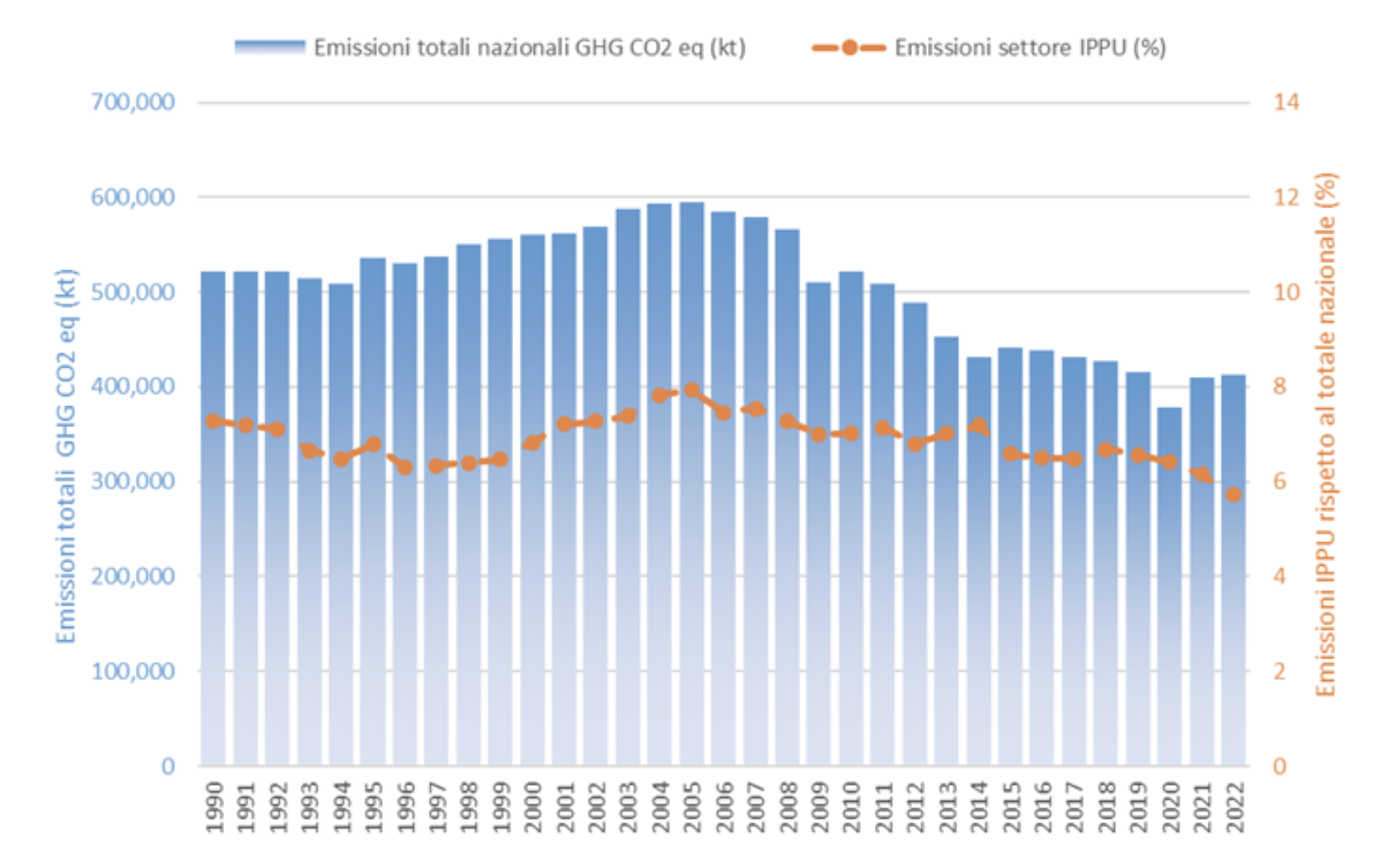
Figure 1. Greenhouse gas emissions (kt) and the contribution of the IPPU sector (Industrial Processes and Product Use) to the national total (source: ISPRA).
Conclusions on How to Reduce a Company’s Carbon Footprint
The industrial sector is one of the sectors that contributes most to global emissions of climate-altering gases, making the adoption of mitigation strategies essential. In fact, in Europe in 2019, the “Industrial Processes and Product Use” sector was the second-largest emitter, accounting for 9.10% of total emissions, second only to the “Energy Production” sector, which alone accounts for nearly 80%.
In Italy, total greenhouse gas emissions are declining year by year, but the industrial sector poses one of the greatest challenges in the transition to a low-carbon economy. The slow pace of decarbonization in this sector is due to its heavy reliance on energy-intensive processes and the use of fossil fuels.
To achieve the ambitious goals set by the European Union—which call for climate neutrality by 2050—it will be essential to accelerate the adoption of innovative technologies, promote energy efficiency, and facilitate collaboration between businesses and the government to ensure a sustainable transition.