



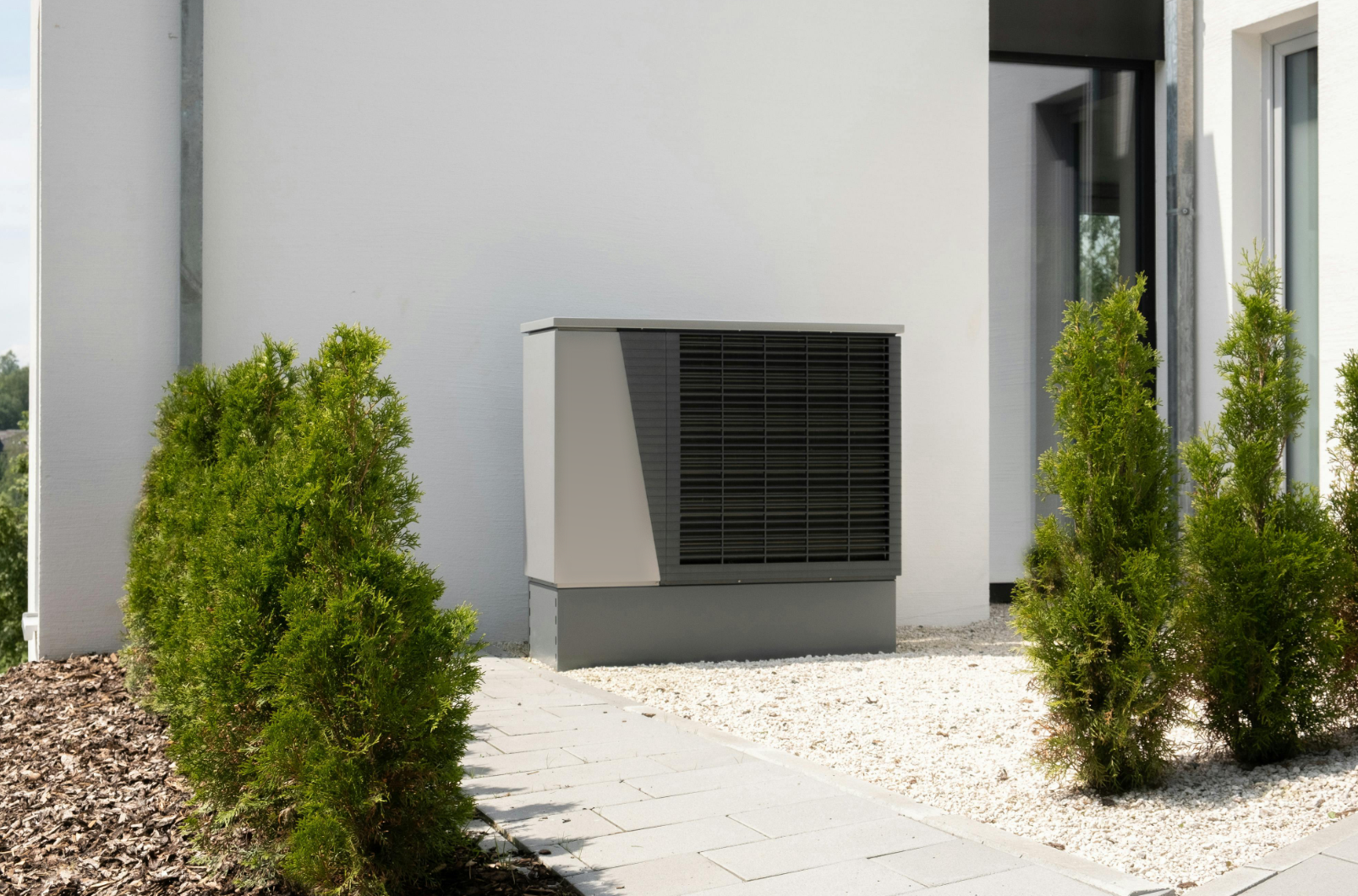
Photo from Pexels
Author: Filippo Sfrattoni
A heat pump is a thermodynamic system capable of transferring heat from a cold environment to a warmer one in the winter, and vice versa in the summer. In winter, it extracts heat from a cold source and transfers it to an indoor space. It is a device that is increasingly used, particularly in the context ofmore sustainable construction. This technology takes advantage of the properties of the refrigerant used, which changes phase under specific pressure and temperature conditions.
We are here to help you
Please contact us for any information you may need.
The latest news from the industry
Receive the latest articles from our blog on your email
How a Heat Pump Works
The system consists of four main components:
- Compressor: increases the pressure of the refrigerant, raising its temperature.
- Throttling valve: reduces the fluid pressure, thereby lowering its temperature.
- Outdoor heat exchanger (evaporator): absorbs heat from the outdoor environment (cold source).
- Indoor heat exchanger (condenser): transfers heat to the indoor environment (heat sink), heating the heat transfer fluid.
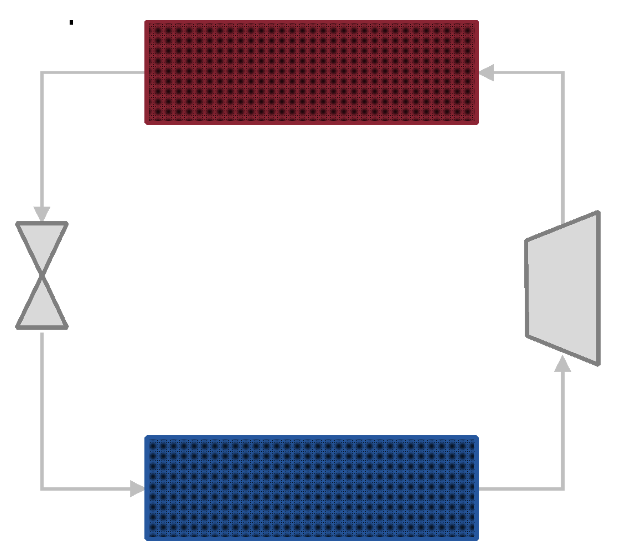
The condenser can use two types of heat transfer fluid for heat exchange:
- the air;
- water.
Similarly, the evaporator can use the following as a heat transfer fluid:
- the air;
- water.
The Different Types of Heat Pumps
Heat pumps are divided into two main categories: those that use air as the heat transfer medium (air-to-air or air-to-water), and those that use water (water-to-water or water-to-air). An alternative to the water-to-water type is the geothermal heat pump.
Air-to-air heat pump
The most common type uses air as the heat transfer fluid. These heat pumps, known as air-to-air or air-to-water heat pumps, are widely used because they are economical and versatile. However, they have limitations: heat pumps are most efficient when the temperature difference between the outdoor air (the cold source) and the space to be heated (the heat sink) is small. When the temperature difference increases, especially on colder days, efficiency decreases. This means that the system operates less effectively precisely during the most critical times of the year, when it is very cold or very hot outside.
Water-to-water heat pump
However, there are other types of heat pumps that use water as a heat transfer fluid (water-to-water or water-to-air). These systems are generally more stable and efficient than air-source systems because water naturally maintains a much narrower temperature range and, in winter, never drops below 0°C. This characteristic ensures high and consistent performance, reducing electricity consumption and, consequently, operating costs. The main disadvantage of water-source heat pumps is the difficulty in finding a suitable water source—such as groundwater, rivers, or streams—for private use.
Access to these resources may be limited and bureaucratically complex, making the adoption of this technology less common than that of air-based technology.
Geothermal Heat Pump: What It Is and How It Works
Another type of water-to-water or water-to-air heat pump is one that harnesses the thermal energy of the ground, a solution that is particularly advantageous in terms of energy efficiency. The temperature underground, at a certain depth, remains constant throughout the year and is not affected by seasonal variations. This allows the heat pump to maintain consistently high performance, resulting in energy and cost savings. In this case, the system is referred to as a geothermal heat pump. The system involves installing a coil in contact with the ground, appropriately sized to extract sufficient heat for geothermal heating of indoor spaces. The two main types of heat exchange circuits that can be implemented are:
- Horizontal probes: This solution is more economical and easier to implement, with the coil installed at a depth of between 1 and 5 meters. However, it requires a large area of land, which cannot be used for other purposes, such as farming.
- Vertical probes: In this case, the geothermal probes are installed vertically, requiring specialized excavation equipment, which results in higher costs. However, the advantages are significant, as the surface area occupied is reduced, and as depth increases, the ground temperature becomes even more stable, further reducing the temperature variation.
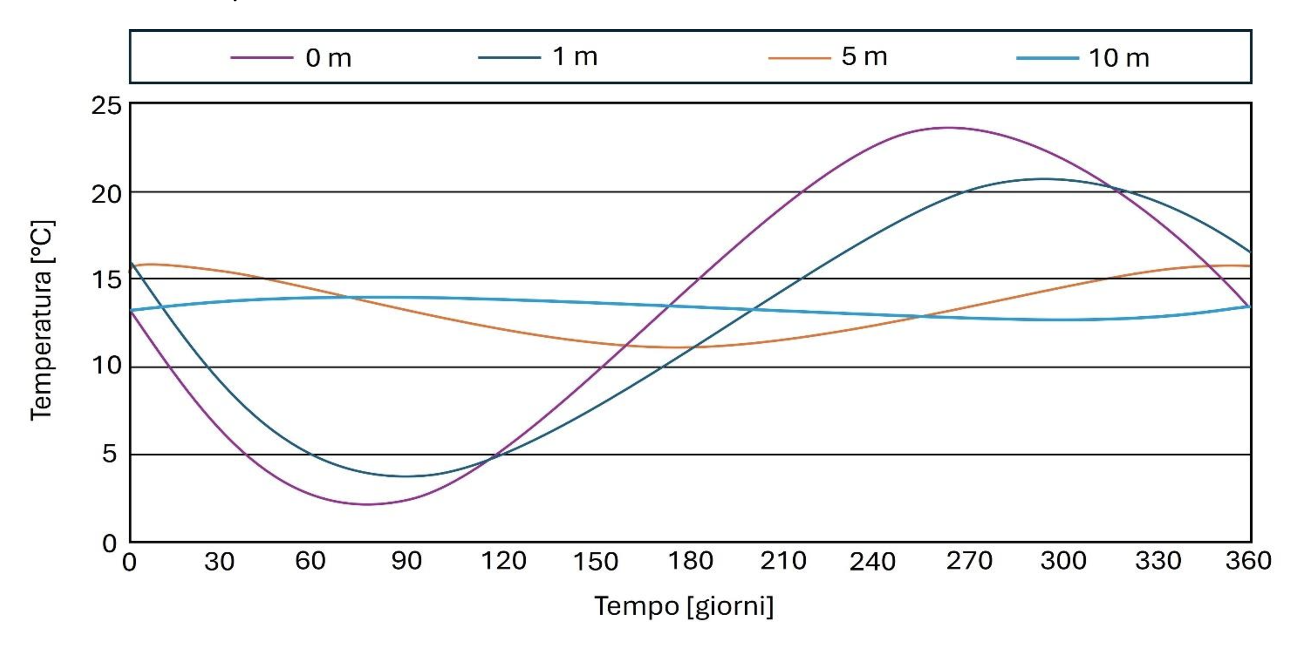
The soil has high thermal inertia: even at a depth of just a few centimeters, daily temperature fluctuations are dampened, while seasonal fluctuations are significantly reduced after just a few meters, as shown in the figure below, where the soil temperature is roughly equal to the average annual air temperature at that location.
Water is often used as a heat transfer fluid because it has no environmental impact. However, water has its limitations: in winter, the ground temperature must not fall below 0°C to prevent freezing. Alternatively, a mixture of water and ethylene glycol can be used, which does not freeze but has higher operating and maintenance costs, in addition to being corrosive and polluting in the event of leaks in the pipes.
Advantages and Disadvantages of Geothermal Heat Pumps
A major advantage of geothermal heat pumps is free cooling. During transitional seasons, such as spring and fall, it is possible to directly utilize the ground temperature to cool indoor spaces, bypassing the heat pump itself—much like what happens in mechanical ventilation systems. This technology offers additional potential when combined with solar panels and thermal storage systems.
The benefits of geothermal heat pumps are particularly evident in medium-sized systems, such as apartment buildings, businesses, schools, and offices, where the payback period is much shorter than for small residential systems.
However, there are also some drawbacks. The first is the installation cost, which can be as much as double that of an air-to-air heat pump. Despite this, the payback period tends not to be too long thanks to the technology’s high efficiency. Another issue concerns maintenance: in the event of a breakdown, replacing a geothermal probe located several tens of meters underground can be very costly. Finally, there is the legislative issue. At the European level, there is no unified regulation governing the installation of geothermal heat pumps, and in many countries, there are no standards or guidelines for designers. This regulatory gap hinders the wider adoption of the technology, creating uncertainty for both designers and builders.
In conclusion, geothermal heat pumps offer a highly efficient and beneficial option for decarbonization, especially for medium-sized systems, but they require a significant initial investment and clear regulations to support their widespread adoption.