



Author: Federico Re Ferrè
Key Points
- The white certificates, also known as Energy Efficiency Certificates (TEE), are certificates issued by the Energy Services Operator (GSE) that certify the achievement of energy savings.
- A white certificate is issued if the applicant demonstrates that they have achieved energy savings through an energy efficiency.
- Since white certificates are negotiable instruments, obligated parties who are unable to obtain the Energy Efficiency Certificates through energy efficiency improvements may purchase them on a regulated market.
- To qualify for the white certificates , the first step is to register on the Energy Services Operator (GSE) portal, followed by accreditation.
- White certificates offer a tangible opportunity to turn investments in energy efficiency into a lasting economic benefit.
In this article, we’ll take a look at the features of white certificates, the application process, and some essential information.
Table of Contents
- What Are White Certificates?
- Who Is Eligible for White Certificates?
- How much are white certificates worth?
- Procedure for Accessing White Certificates
- Service Life of the Improvements
- Frequently Asked Questions About White Certificates
- Which projects qualify for white certificates?
- How long does it take to obtain white certificates?
- Can white certificates be combined with other incentives?
- White Certificates: An Economic Opportunity for Energy Efficiency
What Are White Certificates?
I white certificates, also known as Energy Efficiency Certificates (TEE), are headings issued by the Energy Services Manager (GSE) that attest to the achievement by energy savings.

Who Is Eligible for White Certificates?
A white certificate is issued if the applicant demonstrates that they have achieved energy savings through an energy efficiency.
White certificates are recognized for each TEP (Metric Tonne of Oil Equivalent) by energy conservation and last from 3 to 10 years depending on the procedure. They log in to Energy Efficiency Certificates (TEE):
- The obligated parties: distributors of thermal energy and electricity with at least 50,000 end users
- I volunteers: ESCo, public and private entities that have a EGE (Energy Management Expert) a certificate confirming that it is authorized to perform the procedure and public and private entities that have adopted a Energy Management System certificate ISO 50001.
How much are white certificates worth?
Since these are negotiable securities, the obligated parties that are unable to obtain the Energy Efficiency Certificates through energy energy efficiency can purchase them on a regulated market, in this case the GME (Energy Markets Operator).
Organizations wishing to participate in the TEE but do not have an EGE can still participate through an ESCo.
The white certificates obtained can then be sold on the market. Since obligated parties who do not reach the minimum threshold they must purchase them; this mechanism creates a financial penalty for those who are inefficient and a incentive for those manages their site.
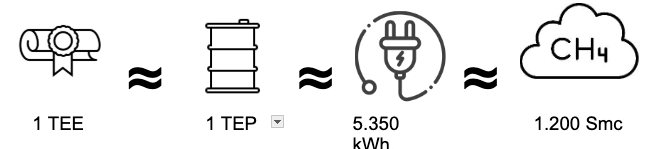
A Energy Efficiency Certificate (TEE) is equivalent to 1 TEP of savings which translates to approximately 5,350 kWh of electricity or 1,200 Smc of natural gas. A TEE costs about 250 €, though the market value may vary GME.
The total savings amount to approximately €1,000 per year when added to the value of the white certificate and theenergy saved (taking into account 0.17 €/kWhe we would have an additional 909 € extra; if, on the other hand, we were to consider 0.40 €/Smc we would get €480).
Procedure for Accessing White Certificates
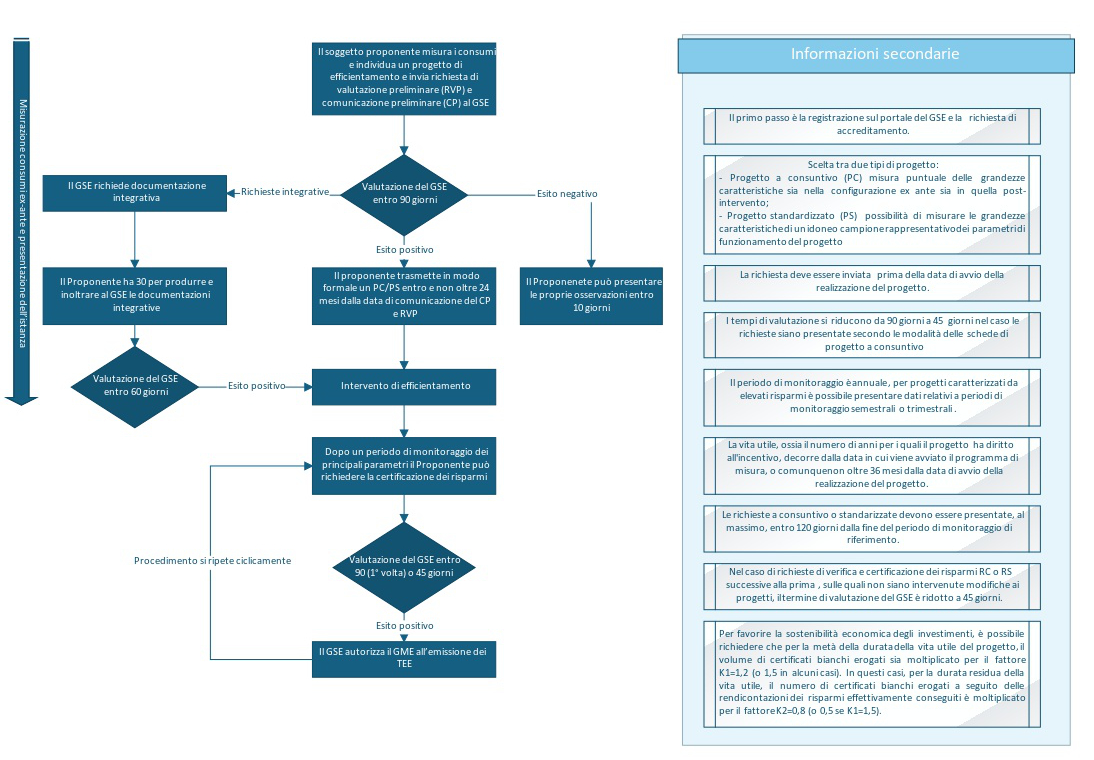
To qualify for the white certificates , the first step is to register on the Energy Services Manager (GSE) portal, followed by accreditation. Once you’ve identified a energy efficiency project and having measured energy consumption you can request a preliminary assessment from the GSE , which must respond within 90 days. The GSE may result in positive, a positive with a request for additional documentation or a negative:
- In the first case, the Proposer must then formally submit a final project report (PC) or standardized (PS) no later than 24 months from the date of notification of the request for a preliminary assessment;
- In the second case, the Energy Services Manager (GSE) requires a supplementary documentation that the Proposer must produce and forward by 30 days and that it will be evaluated by the GSE by 60 days;
- In the third case, the GSE rejects the request, and the Proponent has 10 days to submit their comments along with attached documents.
Once the the Proponent may then implement theenergy efficiency project and, after a period of monitoring of energy consumption —usually annual, request certification of the savings.
The GSE has a timeframe of 90 days to certify the savings and authorize therefore the GME to issue the TEEs. In order to obtain positive outcome it is necessary that the PCs have generated an amount of additional savings of no less than 10 TOE in the first 12 months of monitoring, decreasing to 5 TEP for the PS.
Whether they are final or standardized, claims must be submitted no later than 120 days after the end of the relevant monitoring period.
The procedure for monitoring savings and submitting requests to the GSE is then repeated on a cyclical basis , and if, after the first request, there have been no changes to the projects the GSE’s GSE is reduced to 45 days.
Service Life of the Improvements
Since some procedures may be costly and it would be desirable to recoup the costs more quickly during the first few years after the project is completed; it is possible to request multiply the volume of the Energy Efficiency Certificates (TEE) by a factor of 1.2 or 1.5 (in the case of the civil and transportation sectors) for the first half of the project’s useful life; in these cases, however, for the remainder of the useful life, the white certificates are subject to a multiplier of 0,8 or 0,5 depending on the multiplier of the first multiplier.
The service life depends on the type of procedure and whether it is classified as new installation, replacement or integrated efficiency upgrade. The table below shows the useful life of some of the measures most highly regarded in the civil sector and industrial.
| Sector | Project | Service Life (years) | ||
| New Installation | Replacement | Integrated Energy Efficiency Upgrade | ||
| Industrial Sector | Regenerative Burners | 7 | 5 | |
| Networks, Services, and Transportation Sector | CED | 7 | 5 | |
| Networks, Services, and Transportation Sector | Heat Recovery for District Heating and/or District Cooling Networks | 7 | 7 | |
| Networks, Services, and Transportation Sector | Improving the Efficiency of Electricity, Gas, and Water Networks | 7 | 7 | |
| Industrial Sector | Firing/Melting/Secondary Processing Furnaces | 10 | 7 | 5 |
| Industrial Sector | Electrolysis Plants | 10 | 7 | |
| Industrial, civil (residential, commercial), and agricultural sectors | Thermal insulation of opaque heat-dissipating surfaces | 10 | ||
| Sector: Civil (Residential, Commercial) and Agricultural | Air handling units and mechanical ventilation systems | 10 | 7 | 5 |
Frequently Asked Questions About White Certificates
Which projects qualify for white certificates?
There are a variety of eligible projects, such as: installation of energy-efficient systems, thermal insulation of buildings, heat recovery in industrial processes, improving the efficiency of electrical grids and gas, installation of cogeneration systems and much more. However, each project must demonstrate a minimum energy savings.
How long does it take to obtain the white certificates?
The process takes several months. After registering and obtaining accreditation on the GSE portal, the preliminary assessment takes up to 90 days. Once the procedure has been performed, after the period of monitoring (usually 12 months), the GSE has 90 days to certify the savings and authorize the issuance of TEEs. For subsequent requests, if there are no changes, the processing time is reduced to 45 days.
Can white certificates be combined with other incentives?
The Cumulative Nature of white certificates with other incentives (such as the Conto Termico, tax deductions, etc.) depends on the current regulations and the type of project. In general, it is not possible to combine the white certificates with incentives that cover the same eligible costs. It is essential to check in advance with the GSE the eligibility of incentives for their specific project.
White Certificates: An Economic Opportunity for Energy Efficiency
The White certificates represent a concrete opportunity to transform investments into energy efficiency into a lasting economic benefit. To maximize the benefits, it is advisable to rely on qualified professionals (EGE or ESCo) who can oversee the entire procedural process, from the preliminary assessment to monitoring of savings.
The bureaucratic complexity should not discourage you: the financial return, combined with the contribution to environmental sustainability, makes this mechanism particularly advantageous for companies and public agencies planning energy-efficiency energy energy.
For more information and personalized advice on white certificates please contact our Enertech Solution team.