



Author: Federico Re Ferrè
Key Points
- A cleanroom is an area characterized by stringent cleanliness and air control requirements to prevent contamination of the products or items contained within.
- The classification of cleanrooms is defined by the ISO 14644-1, which divides them into 9 classes based on the concentration of particulate matter per cubic meter of air.
- To meet such stringent requirements, the following are necessary: high air changes per hour and high filtration efficiencies, achieved using HEPA or ULPA filters.
- Airflows can be turbulent or laminar, with vertical configurations or horizontal depending on the class ISO class required.
- Managing differential pressure is essential to prevent contamination, keeping the cleanroom at a higher pressure than the adjacent areas.
One clean room, known in English as “cleanroom“, is an area characterized by strict cleaning requirements and air control in order to Do not contaminate the products or the items contained therein. The clean room is used in a wide range of sectors, including:
- sector food;
- sector aerospace;
- electronics;
- pharmaceutical industry.
This article will outline the main system specifications and the requirements necessary to ensure a very high level of cleanliness.
Cleanroom Classification: Filtration Classes
The standard most commonly considered for the air quality requirements for cleanrooms is ISO 14644-1 , which establishes a classification system for cleanrooms based on concentration per m³ of particulate matter in the air.
The following is the classification of the standard which covers 9 classes of cleanrooms from 1 (most efficient) to 9 (less efficient). It is worth noting that the concentrations per cubic meter The following are cumulative of all particles of the specified size and larger; for example, a 4th grade has a limit of 2.370 particles from 0.2 µm or higher, so 2.370 includes all particles larger sizes such as 0.3 µm (which have a limit 1.020), 0.5 µm (which have a limit 352) and so on.
| ISO Classification | Maximum permissible concentration (particles per m³) for particles equal to or larger than the sizes listed below | |||||
|---|---|---|---|---|---|---|
| 0.1 µm | 0.2 µm | 0.3 µm | 0.5 µm | 1 µm | 5 µm | |
| ISO Class 1 | 10 | |||||
| ISO Class 2 | 100 | 24 | 10 | |||
| ISO Class 3 | 1,000 | 237 | 102 | 35 | ||
| ISO Class 4 | 10.000 | 2.370 | 1.020 | 352 | 83 | |
| ISO Class 5 | 100.000 | 23.700 | 10.200 | 3.520 | 832 | |
| ISO Class 6 | 1.000.000 | 237.000 | 102.000 | 35.200 | 8.320 | 293 |
| ISO Class 7 | 352,000 | 83,200 | 2,930 | |||
| ISO Class 8 | 3,520,000 | 832,000 | 29,300 | |||
| ISO Class 9 | 35,200,000 | 8,320,000 | 293,000 | |||
Air Filtration in Cleanrooms
To meet such stringent requirements, it is necessary to provide for high air exchange rates and high filtration efficiency. The filtration classes of the filters are governed by several standards, but filters can be divided into four groups:
- Filters coarse;
- Filters medium;
- Filters Fine;
- Filters Absolute.
A cleanroom requires absolute filters, usually called HEPA HEPA (High Efficiency Particulate Air filters) or ULPA (Ultra Low Penetration Airfilters), depending on their filtration efficiency. The requirements of the Absolute filters are specified by UNI EN 1822-1, which illustrates the difference between aoverall efficiency and a local efficiencyof the filter.
Efficiency also depends on the the larger size of the penetrating particle, that is, the Most Penetrating Particle Size, abbreviated as MPPS. As of today, the MPPS has reached values close to 0.08 µm thanks to next-generation materials.
| Filtration Type | Filtration class EN 779 | Efficiency |
| Coarse filters | G1 | <, 65 |
| G2 | 65 ≤ Am < 80 | |
| G3 | 80 ≤ Am < 90 | |
| G4 | 90 ≤ Am | |
| Medium and Fine Filters | M5 | 40<Em<60 |
| M6 | 60 ≤ Em<80 | |
| F7 | 80 ≤ Em<90 | |
| F8 | 90 ≤ Em<, 95 | |
| F9 | 95 ≤ Em | |
| Filtration Class EN 1822 | Overall Efficiency | |
| HEPA Absolute Filters | H10 | 85≤Eg |
| H11 | 95 ≤ Eg | |
| H12 | 99.5 ≤ Eg | |
| H13 | 99.95 ≤ Eg | |
| H14 | 99.995 ≤ Eg | |
| ULPA Absolute Filters | U15 | 99.9995 ≤ Eg |
| U16 | 99.99995 ≤ Eg | |
| U17 | 99.999995 ≤ Eg |
Types of Ventilation and Air Exchange Rates
The airflows in a cleanroom can be of two types:
- Turbulent: the air comes admitted through vents creating a turbulent flow which dilutes the contaminants and then it becomes excerpt from the grids of shots placed in the sections low of the walls (from ISO 6 to ISO 9) or to ceiling (ISO 8 and ISO 9).
- Vertical laminar flow: In this configuration, the airflow always comes from the suspended ceiling but in an almost uniform (the filter modules must cover at least80% of the surface of the suspended ceiling) in order to be pushed downward by the so-called “piston effect” and be extracted at the level of the floating floor. In this configuration, the floor consists of perforated tiles to allow air to flow through the entire floor surface.
- Horizontal laminar flow: This type is similar to the previous one, but theair is introduced through a wall equipped with filter modules and extracted from the opposite wall consisting of return grilles.
From left to right: a turbulent-flow cleanroom, a vertical laminar-flow cleanroom, and a horizontal laminar-flow cleanroom.
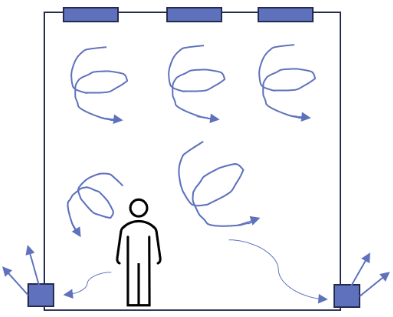
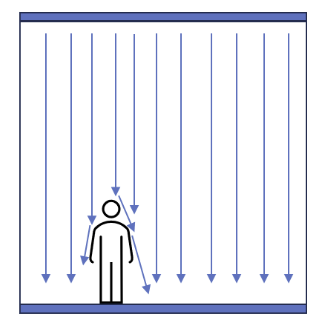
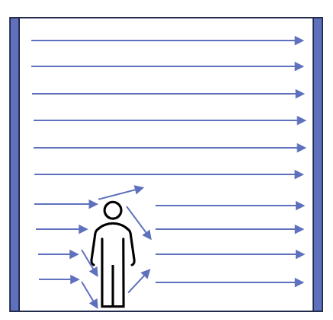
The laminar flow ventilation is required for classrooms with the most stringent requirements—namely, ISO Class 1 to ISO 5 , while the remaining ISO have a turbulent flow.
Another essential factor in preventing contamination is the presence of a differential pressure typically ranging from 5 to 20 Pa: this pressure difference is necessary to maintain positive pressure in the cleanroom and ensure that any airflows causedby opening the doors always carryair out of the cleanroom and never into it.
In the event that, prior to the clean room there is a gray room, this must have a positive pressure compared to theexterior (for example 5 Pa) but anyway lower than the adjacent cleanroom (which will be at 15–20 Pa) in order to create a pressure drop that prevents entry into the cleanroom with contaminated air.
The most distinctive features listed in this article are summarized in the following table, which also lists the sectors where this type of structure is most in demand.
| Class | Concentration of particles larger than 0.1 µm per cubic meter | Airflow | Filters | Air changes [vol/h] - air velocity [m/s] | Ceiling coverage [%] | Applications |
|---|---|---|---|---|---|---|
| ISO Class 1 | 10 | Unidirectional laminate | ULPA U15 | 0.3–0.5 m/s | >90% | Nanotechnology, Advanced Semiconductors |
| ISO Class 2 | 100 | Unidirectional laminate | ULPA | 0.3–0.5 m/s | >90% | Microchip |
| ISO Class 3 | 1.000 | Unidirectional laminate | ULPA | 0.3–0.5 m/s | >90% | Aerospace |
| ISO Class 4 | 10.000 | Unidirectional laminate | ULPA/HEPA | 0.3–0.5 m/s | >90% | Precision Optics |
| ISO Class 5 | 100.000 | Unidirectional laminate | HEPA H14 - ULPA | 0.2–0.5 m/s | >80% | Sterile Pharmaceutical Products, Operating Rooms |
| ISO Class 6 | 1.000.000 | Turbulent | HEPA H14 | 70–160 vol/h | 30-50% | Medical Devices |
| ISO Class 7 | 352,000 (from 0.5 µm) | Turbulent | HEPA H13-14 | 30–70 vol/h | 15-20% | Workshops |
| ISO Class 8 | 3,520,000 (from 0.5 µm) | Turbulent | HEPA H13 | 10–20 vol/h | 5-10% | Non-sterile pharmaceuticals |
| ISO Class 9 | 35,200,000 (from 0.5 µm) | Standard | Pre-filters | <10 vol/h | / | Utility Corridors, Transit Areas |
FAQ
What are cleanrooms?
A clean room, known in English as “cleanroom,” is an area characterized by strict cleanliness requirements and air control in order to prevent contamination of the products or the items contained therein.
How many and what are the filtration classes for cleanrooms?
The standard ISO 14644-1 establishes a classification system for cleanrooms based on concentration per m³ of particulate matter in the air, covering 9 cleanroom classes ranging from ISO 1 (most efficient) to ISO 9 (least efficient).
The Enertech Solution Method for Addressing Critical Issues in Cleanrooms
Cleanroom efficiency requires integrated expertise in ISO classification, air filtration, ventilation, air changes, and pressure control.
Enertech Solution supports companies and organizations through a proven method based on technical analysis, plant design, and verification of regulatory requirements, taking a structured approach to addressing challenges associated energyenergy efficiency and environmental monitoring.
The Enertech method begins with an analysis of production needs and cleaning requirements, and continues with the definition of the most suitable plant engineering solutions (ventilation, filtration, air changes, and differential pressures) and concludes with ongoing technical support aimed at ensuring performance, reliability, and regulatory compliance.
For more information please contact our Enertech Solution team.