



Author: Federico Re Ferrè
Key Points
- Industrial power factor correction reduces the phase shift between voltage and current in systems with inductive loads.
- A low power factor results in penalties, Joule losses, and higher infrastructure costs.
- Reactive power does not produce useful work but consumes capacity in the electrical grid.
- Capacitors provide reactive power locally, improving the system’s energy efficiency.
- Proper power factor correction results in cost savings and technical optimization of the industrial plant.
In the civil sector, the electrical power used is almost entirely active, meaning that the power measured in kW. In the field of industrial however, the presence of inductive loads results in a phase shift between voltage and current or the voltage waves and current reach their peaks at different times.
The active active power consumed by a single-phase load is therefore calculated as: P = |V| |I| cos(φ)
In this formula: φ isthe phase angle between the voltage and the current.
The cos(φ) is sometimes also referred to as the power factor in the case of linear loads. The phase shift is present both for a single machine, such as an electric motor, as well as for an entire building. So we have three powers:
- active;
- reactive;
- apparent.
Table of Contents
- The Triangle of Powers
- Why Reactive Power Is a Cost to the Grid
- Power Factor and Rate Structure: When Charges Apply
- What Is Industrial Power Factor Correction and How Does It Work?
- What are the methods for power factor correction?
- The Benefits of Industrial Power Factor Correction for Businesses and Utility Providers
- Frequently Asked Questions About Power Factor Correction
- Industrial Power Factor Correction as a Lever for Energy Efficiency
The Triangle of Powers
Powers can be represented by a triangle in which the phase shift between active power and apparent power is the same as that between voltage and current.
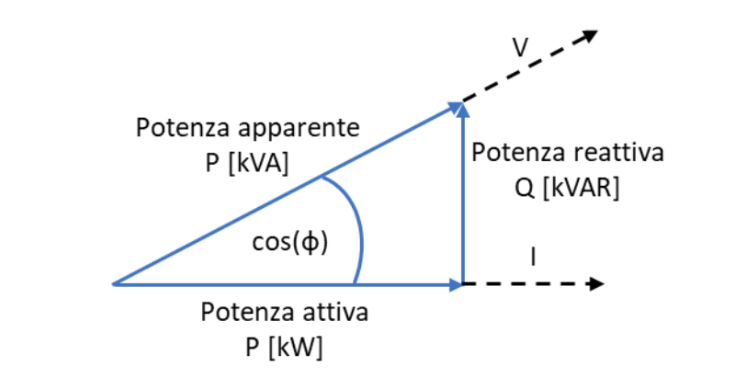
Figure 1. Representation of powers: the powers form a right triangle such that S² = P² + Q²
Why Reactive Power Is a Cost to the Grid
The power that produces work and is actually paid is that active but the lines also carry the reactive. To better illustrate this concept, consider the following analogy: a glass of lemonade with ice.
What we want and pay for when we order the drink is lemonade; what we’re served is a mixture of lemonade and ice; the more ice there is, the less lemonade is in the glass, so we’d like just the right amount of ice to keep the drink cool, but not so much ice that it significantly reduces the amount of lemonade.
In this analogy, the glass represents the capacity of the power line: too much ice forces you to order more glasses to quench your thirst, just as excessively high reactive power means an increase the cross-sectional of conductors in order to carry more active power.
Differences Between the Civil and Industrial Sectors
In residential settings, a large portion of the loads is purely resistive (electric water heaters, irons, conventional ovens, incandescent light bulbs, hair dryers), and there isn’t much reactive power.
In industrial applications, on the other hand, loads are generally higher, and the reactive component is significant due to the presence of motors and transformers, in which energy oscillates between the circuit and the magnetic field. Just as ice in lemonade isn’t useless—since it enhances the drink—reactive power isn’t useless either, as it’s necessary to maintain the magnetic fields that are essential for the operation of electric motors and transformers.
Power Factor and Rate Structure: When Charges Apply
The operator of the electric grid therefore has an interest in maintaining low the reactive power since not comes paid directly from theuser final but “takes up space” in the electric grid at the expense of that one active.
The rate structure tends to reward those with power factors close to 1. Low power factors result in high reactive power and, consequently, higher currents; higher currents result in greater Joule losses (losses are proportional to the square of the current, so a 20% increase in current leads to 44% more power dissipation, and a 50% increase in current results in nearly double the power dissipation), which in turn increases transmission costs for the grid.
In addition, transformers and cables must also be sized for reactive component and must therefore be more sturdy (and therefore more expensive) when dealing with higher reactive power.
These infrastructure costs and expenses are borne by the network operator, which therefore incentivizes users to be more responsible by adopting power factors greater than 0.9. In cases involving factors such as lower power less than 0.7 may also require industrial power factor correction.
| Pre-calculated reactive power | cos(φ) | Cost |
| EQ ≤ 0.5 E | ≈ 0.9 | No cost |
| 0.5 E and <, EQ ≤ 0.75 E | 0.8 | Charge at rate c1 for the Eadd portion: Eadd = EQ – 0.5 E |
| 0.75 E < EQ ≤ E | ≈ 0.7 | Charge at rate c2>C1 for the portion Eadd = EQ – 0.5 E |
| EQ >, and | < 0.7 | Required power factor correction |
What Is Industrial Power Factor Correction and How Does It Work?
To resolve the phase-shift problem, a process known as industrial power factor correction is implemented, which involves installing capacitors in parallel with the loads: the capacitors act as sources of reactive power, which therefore does not have to be supplied entirely by the grid.
Less reactive power supplied by the grid results in lower current for the grid operator, who can therefore save money without having to impose surcharges. Capacitors are used in industrial power factor correction because they supply current ahead of the voltage, thereby counteracting the phase shift in the grid.
What are the methods for power factor correction?
The power factor correction industrial can take several forms:
- Distributed: Each load is locally power-factor-corrected by installing a capacitor; this is an effective solution but also expensive;
- For groups: thesystem is divided into several sections, each of which is equipped with a set of capacitors;
- Centralized: a single battery of capacitors located upstream of the plant; the capacitors are added as the load increases following a measurement which determines the cos(φ) and determines whether enter or disengage the steps of capacitors.
Industrial power factor correction typically aims to achieve a power factor close to 0.95. In addition to the fact that a power factor of 1 is impossible to achieve, one must also consider the risk of over-compensation —that is, having a cos(φ) greater than 1 —which would lead to overvoltage problems and malfunctions.
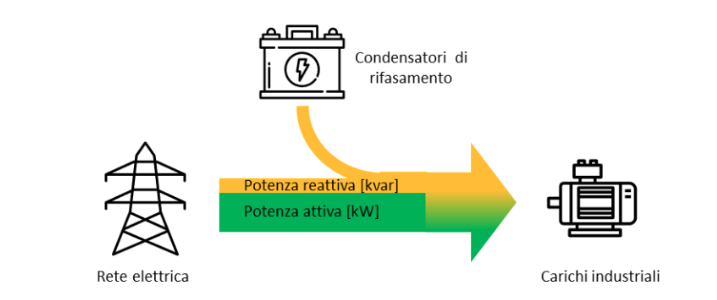
Figure 2. Capacitors do not reduce the load’s reactive power demand; rather, they supply it, thereby relieving the grid of part of the reactive power load.
The Benefits of Industrial Power Factor Correction for Businesses and Utility Companies
The power factor correction therefore allows theuser to independently compensate for reactive power required without relying entirely on the utility, which can consequently operate a more efficient distribution network and less expensive.
In conclusion, the power factor correction in industrial applications is a beneficial solution for both theend user and the utility operator.
Industrial users avoid penalties and reduce losses in their cables, while network operators can run a more efficient network with less power loss and optimally sized infrastructure.
It is important to understand that the power factor correction capacitors do not eliminate reactive power required for the operation of motors and transformers, but the is supplied locally, thereby avoiding the need to transported for kilometers through the power grid.
This simple principle—generatingreactive power where it is needed rather than transporting it from afar, is the foundation ofenergy efficiency of modern .
Frequently Asked Questions About Power Factor Correction
Which power factor values are critical?
Above 0.9 there is no problem for the network operator; between 0.7 and 0.9 there are usually additional charges, below 0.7 rephasing may be required power factor correctionmay be required.
Does power factor correction also reduce the actual amount of electricity I use, as shown on my bill?
Not directly. The power factor correction reduces penalties on the electric bill resulting from a low power factor, but it does not reduce theactive energy consumed from machines to do their useful work. However, there are indirect benefits: by reducing the current flowing through the wires inside the system, the losses due to the Joule in the cables themselves (losses that are included in the electricity bill).
Which loads exhibit inductive power?
Machines as electric motors and transformers require a reactive power while purely resistive machines, such as electric water heaters, electric ovens, certain types of lights do not use resistive power.
Industrial Power Factor Correction as a Lever for Energy Efficiency
The industrial power factor correction is a technical procedure that improves the power factor, reduces losses , and enables companies to avoid penalties related toreactive power.
Compensating for reactive power locally means making the system more efficient, stable and more cost-effective over time.
If you want to check the power factor of your system or evaluate an industrial power factor correction project, please contact the Enertech team for a technical analysis and personalized consultation.