



Key Points
- The electric motors account for up to 74% of industrial energy consumption: optimizing them is a priority.
- An inverter regulates the speed of the electric motor by varying the frequency.
- The Traditional systems dissipate energy, whereas the inverter uses it efficiently.
- Theefficiency of inverters can reach up to 95%, resulting in tangible and measurable savings.
- The payback period can be less than one year.
The electric motors They are among the most widely used machines in the industrial sector. According to estimates ENEA approximately 74% ofelectricity consumed in the Italian industrial sector is attributable to motor systems.
According to theIEA , on the other hand, nearly 50% ofworld’s electricity is consumed by electric motors , with percentages reaching as high as 70% in some sectors. I electric motors are, in fact, essential for powering:
- compressors;
- fans;
- pumps;
- other rotary machinery.
Even in the civil sector there is a significant presence of electric motors as they are indispensable for water distribution and heating systems.
Table of Contents
- What determines the rotational speed of an electric motor?
- How Does an Inverter for Electric Motors Work, and What Is It Used For?
- Efficiency classes for electric motors according to IEC standards
- Energy Savings with Inverters: Data and Application Examples
- Induction Motors and Speed Control with Inverters
- Industrial Applications of Inverters
- Types of Inverters for Industrial Applications
- Differences Between Variable-Frequency and Constant-Frequency Inverters: Inverters for Photovoltaic Systems
- Frequently Asked Questions About Inverters
- Inverters as a Strategic Tool for Energy Efficiency
What determines the rotational speed of an electric motor?
The rotational speed of a electric motor is determined by the number of poles and from the voltage frequency by power supply; since the network frequency a fixed parameter (50 Hz (for Italy), electric motors typically operate at constant speed.
How Does an Inverter for Electric Motors Work, and What Is It Used For?
An inverter for an electric motor allows you to vary the frequency and therefore the rotation speed . An inverter motor is more efficient than a traditional motor because it drastically changes the regulation principle.
The Limitations of Traditional Electric Motor Systems
In a traditional electric motor we have a control using dissipative (throttling valves, dampers, and the like); therefore, a certain amount of energy to the fluid than is necessary, which is then dissipated—and thus wasted.
The Role of the Inverter in Preventing Energy Waste
To achieve the optimal point and avoid wasting energy, bythe use of an inverter , modulate the speed and/or torque required so as to provide almost exactly therequired energy without having to dissipate it. In the following images, you can see the difference in efficiency between a dissipative system and a non-dissipative.
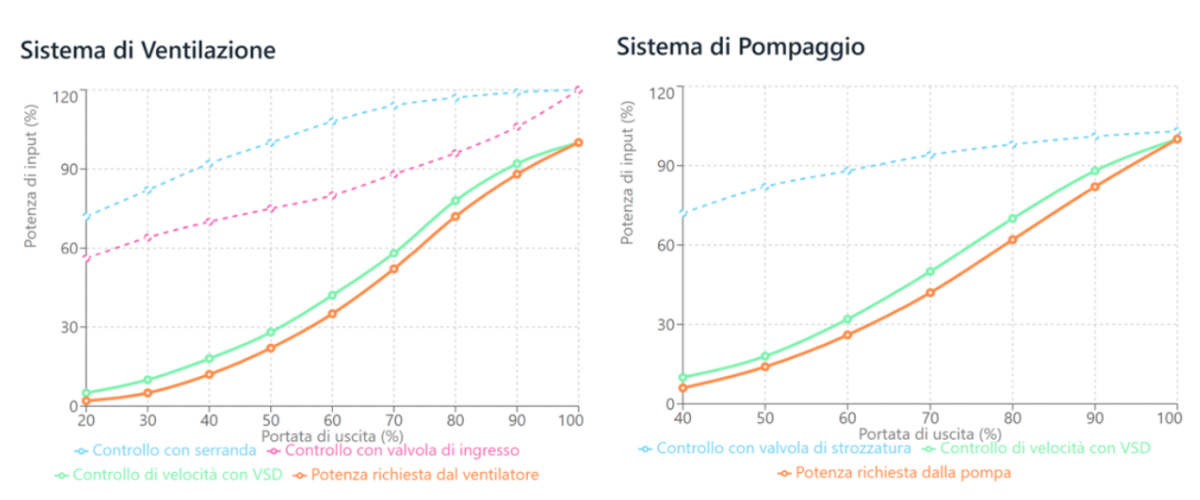
The difference between the required power (orange) and the power output with inverter (green) is theefficiency of the inverter which reaches approximately 95%.
Efficiency Classes for Electric Motors According to IEC Standards
The electric motors do not, however, all have the same efficiency; the efficiency classes defined by the international standard IEC 60034-30-1 are as follows:
- electric motor IE1 (standard efficiency);
- electric motor IE2 (high efficiency);
- electric motor IE3 (premium efficiency);
- electric motor IE4 (super-premium efficiency).
The IE5 efficiency class is still being defined, while the IE1 class It is no longer on the market. Switching from a motor electric IE2 single-phase IE4 can result in a increase in efficiency of 2–3%, which translates to significant savings on large-scale systems.
The electric motors are, however, often overlooked when it comes toenergy efficiency; it is mistakenly believed that investing in high-efficiency electric motors and inverters is more of an expense than a savings, leading them to choose low-efficiency models.
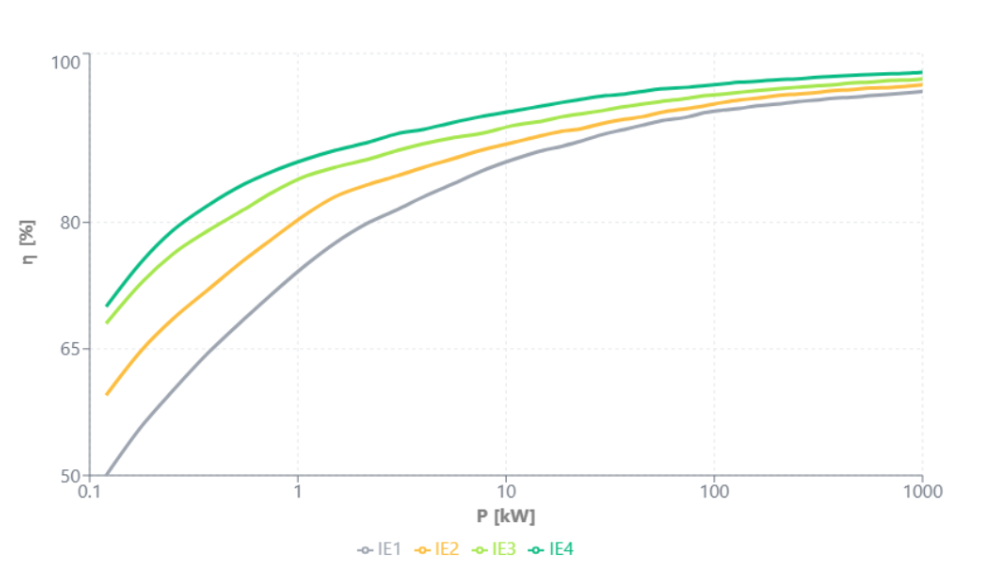
Efficiency of electric motors by class, in accordance with EN 60034-30-1
Energy Savings with Inverters: Data and Application Examples
A FIRE Case Study shows that for a pumping system from 20 kW that works 4,000 hours/year, using a throttle valve this results in a cycle cost of the life of 76,300 €, whereas when using a inverter the value drops to 42,600 €, with a net savings of 33,700 € and a return time of approximately 1 year.
A ventilation , on the other hand, with a power rating of 10 kW operating in three shifts for a total of 7,680 hours per year would result in savings of 42,200 euros over 12 years.
To perform calculations like the ones shown and determine whether theinverter for electric motor is a worthwhile investment, you can consider the following formula to make a preliminary estimate of the payback period of an inverter-driven electric motor.

- T: payback period (years)
- P: engine power [kW]
- Cc: load coefficient (dimensionless)
- h: operating time (hours per year)
- c: cost of electricity (€/kWh)
- effstd: standard motor rated output
- effhem: rated output of a high-efficiency motor
Induction Motors and Speed Control with Inverters
Currently, many of these systems use three-phase induction motors which are excellent simplicity, durability and affordability but that operate at constant speed and do not allow for effective adjustment. The use of inverter, as we have seen, allows for greater efficiency and greater cost savings.
Industrial Applications of Inverters
The inverters are useful in a wide variety of fields, such as:
- pumps and fans for HVAC systems;
- compressors for compressed air and industrial gases;
- elevators and escalators;
- agitators and mixers;
- frames;
- calendras;
- presses;
- centrifuges.
All of these sectors use almost exclusively variable-frequency drives for the reasons mentioned at the beginning.
Types of Inverters for Industrial Applications
There are various types of inverters on the market, each suited to specific application needs.
- The single-phase inverters: used with small motors.
- The three-phase inverters: are the most widely used in industrial settings and cover a wide range of power ratings.
- The digital inverters: are equipped with displays and allow for easier setup and monitoring of parameters.
- The energy-saving inverters: They modulate the operating frequency to reduce electricity consumption.
- The hybrid inverters: manage photovoltaic connected to batteries and the power grid.
- Stationary power inverters are used in continuous-duty applications such as compressors and refrigeration systems.
Differences Between Variable-Frequency and Constant-Frequency Inverters: Inverters for Photovoltaic Systems
A special mention is also due constant-frequency inverters which convert the direct current into alternating current at 50 Hz. The latter inverter are used in solar power systems and in the uninterruptible power supplies where necessary convert the direct current in alternating for the public network or the utility accounts that absorb it.
In the case of photovoltaic systems, the inverter plays a broader role than simply conversion of electrical current. In addition to transforming theenergy generated by the DC-to-AC panels, manages the overall operation of the system, while monitoring the performance and adjusting the of energy into the grid or into storage systems.
This means that the choice ofphotovoltaic inverter cannot be separated from the system sizing: the power rating must be consistent with the installed capacity.
In this case, therefore, we are not talking about energy efficiency but rather a conversion necessary for the appliances to function.
Why does an inverter help you save money?
An inverter helps you save money because it is not a energy-wasting control logic —that is, a system in which energy is supplied to the fluid much more energy than is necessary , which is then largely dissipated to achieve the final result. A Modula inverter modulates the power supply frequency of the electric motor in order to reduce the electricity consumption when necessary.
Do inverters require special maintenance?
The modern inverters are reliable devices that require minimal maintenance. All it takes is a Periodic cleaning of the cooling fans and a visual inspection of the connections.
For which systems is it most cost-effective to install an inverter?
The inverters are particularly advantageous in systems that operate for many hours per year (over 3,000 hours), have variable loads (pumps, fans, compressors), require frequent adjustments in speed or flow rate, and currently use energy-wasting methods (valves, dampers).
Inverters as a Strategic Tool for Energy Efficiency
The inverters for electric motors are therefore an essential component forenergy efficiency , especially in the industrial sector. Using them results in a considerable cost savings with competitive payback periods and improved system performance.
For more information on inverter applications in electric motors please contact the Enertech Solution.