



Photo by Zoshua Colah on Unsplash
Author: Luciana Carvalho
Key Points
- Theenergy efficiency in schools is key to reducing energy consumption and emissions from the existing building stock.
- The EPBD Directive guides energy retrofitting in Europe with clear goals toward decarbonization by 2050.
- The most effective interventions focus on the building envelope, systems, lighting and electrification supported by smart technologies.
- The United States offers advanced models such as New York and Lincoln, which have structured plans for electrification and the use of geothermal energy.
- Preliminary assessments, project priorities, and targeted interventions make it possible to adapt solutions even to historic or protected buildings.
The topic of sustainability of buildings It has become increasingly important in recent years, especially in the fight against climate change. In fact, existing buildings account for approximately 37–40% of global global greenhouse, 40% of energy consumption and 50% of gas consumption in the European Union. To reduce this impact, various policy initiatives—both voluntary and mandatory—have been introduced in recent years.

Table of Contents
- Introduction to Energy Efficiency in Schools
- The EPBD and the European Framework for Energy Renovation
- Key Measures for Improving Energy Efficiency in Schools and Buildings
- The Challenges Facing Existing School Buildings
- Energy Efficiency in Schools: Guidelines from the U.S. Department of Energy
- The New York Model for the Electrification and Decarbonization of Schools
- The five levels of intervention defined by the SCA
- Work on the Envelopes of Historic School Buildings
- The Lincoln Case: Geothermal Energy for Energy Efficiency in Schools
- Energy Efficiency in Schools: What We Can Learn from American Models
- Enertech Solution’s Approach to Energy Efficiency in Schools
The EPBD and the European Framework for Energy Renovation
Among these is the European directive Energy Performance of Buildings Directive (EPBD) plays a key role. Part of the European plan to decarbonization, the Green Deal, also known as “ Fit for 55,” the EPBD was first published in 2002 and has been updated several times over the course of 20 years, until it came into effect in 2024.
The main goal is to accelerate the energy retrofitting energy of the building stock and improveenergy efficiency , and reduce emissions, by 2030 and achieve carbon neutrality by 2050.
Key Measures for Improving Energy Efficiency in Schools and Buildings
Initiatives to improve theenergy efficiency of buildings focus primarily on thebuilding envelope (exterior walls, roof, floor, and windows and doors) and on heating and cooling systems, ventilation and lighting. Alongside these is the growing use of smart technologies for control, which help optimize the management of systems, ensuring comfort and reducing waste.
Theelectrification of buildings, combined with the use of renewable energy, systems such as the electric heat pump, and the use ofgeothermal energy are part of a mix of measures essential for decarbonization.
The Challenges Facing Existing School Buildings
Currently, about80–85% of the existing buildings were built before 2000, and 75% still has low energy efficiency. Although many of the technologies and interventions available today are now well-established and accessible, a significant portion of these buildings have historical value and are subject to preservation restrictions.
This may limit the feasibility of certain solutions, making a thorough initial assessment even more important for setting realistic goals and identifying that are truly capable of that are truly capable of delivering the desired results.
Energy Efficiency in Schools: Guidelines from the U.S. Department of Energy
For this reason, it is important to clearly define the project objectives, whether for a single building or an entire building portfolio, is essential to achieving the best possible result. The U.S. Department of Energy Advanced Energy Retrofit Guide of the United States (DOE Advanced Energy Guide) suggests some key steps:
- Understanding the Building: year of construction, any restrictions, materials and techniques used, system specifications, intended use, and operating hours.
- Analyze the current status and compare it with an energy-efficient building, in order to obtain a clear benchmark.
- Define the objectives: decarbonization, reducing energy consumption, improving the building envelope, indoor air quality, and comfort, etc.
- Collect and analyze energy data.
- Identify the preliminary actions.
- Prioritize actions based on impact, costs, and feasibility.
The New York Model for the Electrification and Decarbonization of Schools
New York City offers a concrete example of how to promoteenergy efficiency and decarbonization of the public real estate portfolio. The plan to Electrification of Schools, updated in 2023, stipulates that any replacement of air conditioning systems in existing buildings must ensure a reduction inenergy use intensity (EUI) of 10% compared to the minimum requirements of the local energy code (NYCECC).
The goal, by 2030, is to electrify between 7 and 10 schools per year, gradually phasing out gas systems in favor of electric systems or powered by biofuels, leading to the complete elimination of gas water heaters.
The NYC School Construction Authority (SCA), which oversees approximately 1,700 public schools, oversees the entire renovation to achieve these energy efficiency in schools, provided that the technical conditions and architectural allow it.
The five levels of intervention defined by the SCA
In fact, many buildings have historical significance, which limits certain types of work on their facades; in other cases, a lack of space prevents the installation of heat pumps. To best manage these situations, the specialists at SCA have defined five levels of project objectives, in order of priority:
- Comprehensive Energy Renovation and Decarbonization: complete electrification of HVAC systems, domestic hot water production, and kitchen appliances; LED lighting; conventional and integrated solar photovoltaic systems; high-performance building envelope.
- Complete electrification of the air conditioning system.
- Full electrification with electrical backup.
- Partial electrification.
- Building Envelope Retrofit.
For each construction era, a set of measures has been defined to energy efficiency measures for schools that have already been preselected, along with an Excel file to help you choose the air conditioning system best suited to the building’s conditions. Everything The material (in English) is available to anyone wishing to evaluate the replacement of systems in line with the objectives of electrification and decarbonization.
Work on the Envelope of Historic School Buildings
Work on the exterior of historic buildings have been carefully planned to preserve theirarchitectural appearance while maximizing energy savings.
At a public school in Manhattan undergoing extensive renovation, for example, the facade was equipped with a new system that protects the original masonry from rain and significantly improves thermal performance thanks to the use of exterior insulation.
Each classroom will also be equipped with a vertical central ventilation unit and a dedicated heat pump , ensuring comfort and reduced energy consumption.
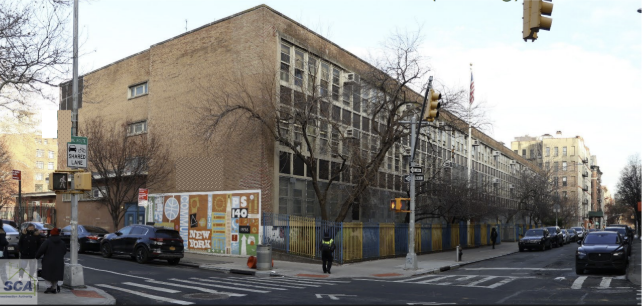
Public School Manhattan (Current status).
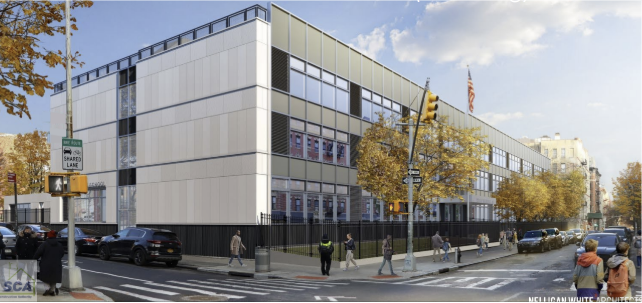
Public School Manhattan (Project Status).
The Lincoln Case: Geothermal Energy for Energy Efficiency in Schools
Another interesting example of decarbonization in schools comes from the city of Lincoln, in the state of Nebraska. Here, as early as 1993, the public schools began usinggeothermal energy for heating, and today it covers virtually all of the approximately 70 municipal schools.
The benefits are clear:
- greater comfort;
- reduced consumption;
- energy intensity (EUI) that is much lower than that of buildings with traditional systems;
- energy costs on average 50%.
The Park Middle School It is one of the most representative cases, so much so that it won the 2024 the “Best in Class for Energy Efficiency and Health” from the Department of Energy (DOE) for its project to energy efficiency of the school and improvement of the air quality internal.
The renovation included the installation of:
- a high-efficiency for heating and cooling;
- LED lighting;
- new windows and doors high-performance;
- a system of mechanical ventilation with heat recovery throughout the building.
The results of the energy efficiency improvements at the school have been remarkable: theEUI has dropped from 92.6 to 24.3, while the energy cost fell to one-third, from 1.51 to 0.53 dollars per square foot of floor area.
Park Middle School, 1st Grade
Park Middle School, after
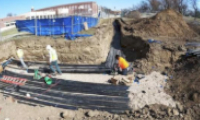
Park Middle School Geothermal System
Energy Efficiency in Schools: What We Can Learn from American Models
The examples from the United States reflect many of the practices already in place in Europe and Italy, where energy efficiency in schools, electrification , and the use of renewable energy are strongly encouraged.
Choose a service package for energy retrofit that best suits your needs, taking into account the actual condition of the buildings and their historical value, makes it possible to achieve concrete results without overestimating costs or benefits. In this way, the goal of achieving the carbon neutrality by 2050 is becoming realistic and achievable.
Enertech Solution’s Approach to Energy Efficiency in Schools
Improving energy efficiency in schools is a crucial step toward reducing energy consumption, enhancing comfort, and moving closer to decarbonization goals. The models analyzed demonstrate how targeted interventions, supported by a rigorous technical assessment, can yield tangible benefits even in complex or restricted buildings.
At Enertech Solution, we use a proven method that integrates energy analysis, design, construction management, and performance monitoring to support public agencies and local governments throughout the entire retrofit process. This is an approach we have already applied in various school settings.
Enertech projects in the education sector: