



Photo by nzooo on Envato
Author: Federico Re Ferrè
Key Points of the Article
-
The photovoltaic EPBT represents the amount of time it takes for a panel to generate the energy consumed in its manufacture, transportation, installation, and disposal.
-
The calculation formula takes into account all stages of the panel’s life cycle and varies depending on the technology used and the installation site.
-
Technologies such as CdTe or monocrystalline in Southern Europe ensure very short EPBTs, even less than two years.
-
Geographic location has a significant impact on EPBT, since a panel’s productivity depends on the available solar radiation.
-
A low EPBT is essential for ensuring the sustainable growth of the photovoltaic sector and promoting energy savings in businesses.
In the fight against climate change, companies’ growing focus on energy conservation has led to an increasingly in-depth analysis of the implications of renewable energy sources, in order to assess their true impact in terms of environmental sustainability.
Solar power is undoubtedly the renewable energy source that has seen the most significant growth over the past two decades. Among the most important metrics for assessing its environmental sustainability isthe solar EPBT, or Energy Payback Time.
Similar to the payback period—which estimates the time needed to recoup an investment—EPBT indicates how long it takes a solar panel to generate the energy required to manufacture itself.
How is the EPBT for a photovoltaic system calculated? Formula and variables
Estimates of a photovoltaic system’s EPBT may vary depending on the assumptions used.
Generally, however, the calculation includes not only the energy used to manufacture the panel, but also that required for transportation, installation, and end-of-life disposal.
Taking these guidelines into account, the formula for determining EPBT can be expressed as follows:
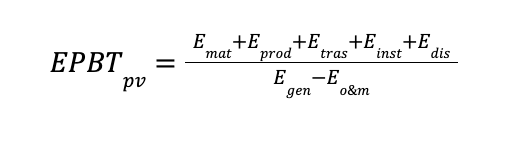
In which:
Andmat = energy expended to produce the material;
Andprod = energy expended in the production of the panel;
Andminus = energy expended for transportation;
Andinst = energy expended for installation;
Anddis = energy expended for the decommissioning of the plant at the end of its life;
Andgen = energy generated by the panel over its entire operational life;
AndO&M = energy expended for panel maintenance and management operations.
We are here to help you
Please contact us for any information you may need.
The latest news from the industry
Receive the latest articles from our blog on your email
How to Interpret the EPBT and Understand Its Real Benefits
The numerator of the formula shown above therefore indicatesthe total energy required to manufacture and operate the panel at its installation site, while the denominator represents the energy actually produced over a period of time, usually one year.
By dividing the energy expended bythe energy produced in a year, we obtain the number of years required for the panel to pay for itself in terms of energy.
It is important to provide some clarifications to avoid common mistakes:
- The energy produced in 1 year (normalized) is equivalent to 1 calendar year
- including factors such as:
- the day-night cycle
- differences in production capacity across different seasons
- different times of day and various unpredictable phenomena, such as rainy days and cloud cover
If we were to achieve an EPBT of 3 years, this would mean that, three years after installation, the panel would have produced an amount of energy equal to that used to manufacture it. This refers to three actual years, not an ideal period of continuous, optimal radiation, since it already accounts for variations due to the day-night cycle, the seasons, and weather conditions.
EPBT and Localization: The Role of Solar Radiation
Therefore, the photovoltaic EPBT depends both on the installation site—which significantly affects the panel’s energy output—and on the technology used, which determines the energy required to manufacture it.
Comparison of Technologies: From Silicon to CdTe, and the Costs of Photovoltaic Panels
There are currently several photovoltaic technologies available, including silicon-based ones, which are among the most widely used on the market today. The most commonly used technologies achieve efficiency levels close to 20% and have a lifespan of about 25 years.
A 2013 article by Peng J. et al. ¹ reports that a monocrystalline silicon panel has an EPBT of slightly more than 2 years when installed in southern Europe, while the same panel, when installed in the United Kingdom, can exceed 7 years due to lower annual irradiance.
- Multicrystalline silicon technology has similar payback periods, which in Southern Europe can be slightly more than 3 years.
- Cadmium telluride (CdTe) technology offers an even more competitive photovoltaic EPBT—around 1 year—thanks to the lower energy required for manufacturing.
- CIS (copper indium diselenide) modules, on the other hand, have slightly higher EPBT values—around 3 years—due to their lower efficiency.
EPBT in Evolution: Increasingly Efficient Systems
To date, thanks to continuous improvements in the efficiency of solar panels and manufacturing processes ( which result in more energy produced by the panel and less energy used in its production) EPBTs in Europe are now under 2 years.
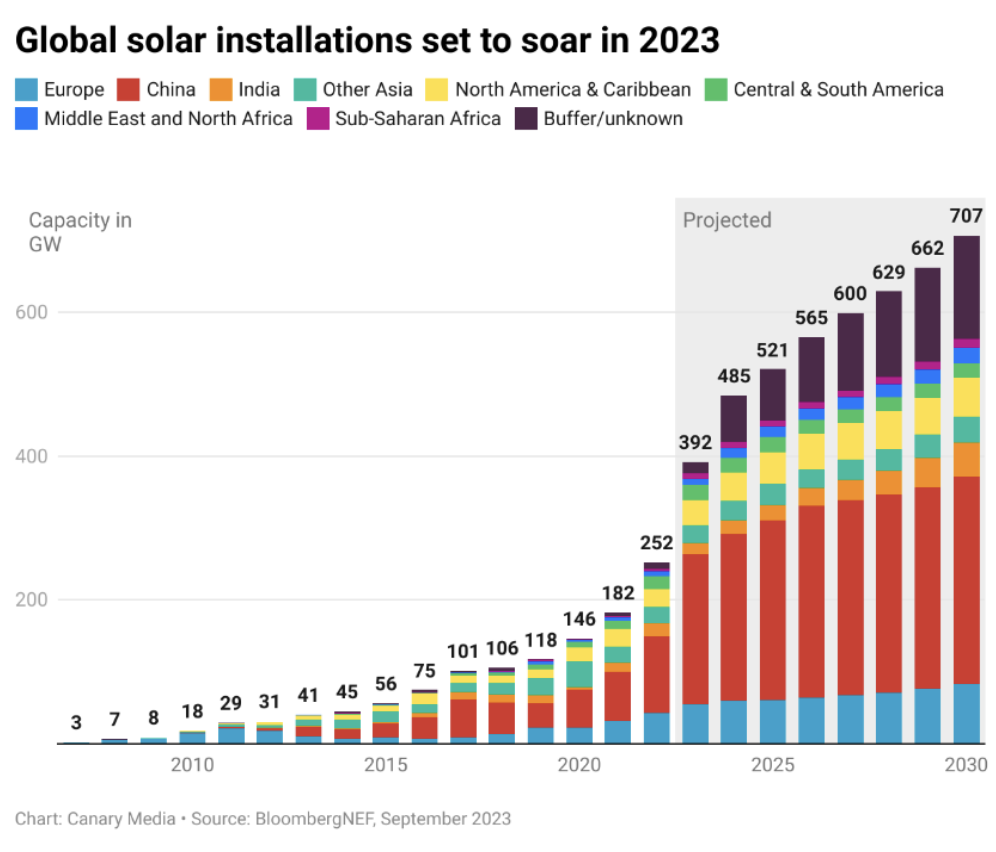
Very low EPBTs make it possible to ensure the sustainability of a rapidly expanding green technology: since photovoltaic installations are growing exponentially, as shown in the image below,the EPBT mustbe low enough to ensure thatthe energy used in their production is covered by renewable sources, in order to guarantee the overall sustainability of the system.
EPBT, Energy Transition, and Energy Conservation in Businesses
Over the years, photovoltaics have become a vital source of energy for reducing climate-altering gas emissions. While EPBTs were still considered unattractive twenty years ago, today—thanks to increased module efficiency and reduced energy consumption in their production—their energy payback times are highly competitive.
Paradoxically, the rapid growth of the photovoltaic sector—which has become exponential thanks to ever-lower costs resulting from large-scale production—has become a potential problem for sustainability: in fact, an EPBT of less than two years is now required to recoup the energy expended in increasingly large-scale production.
In particular, the EPBT must be less than the production doubling time ²
To date, payback periods of less than two years—and in some cases as short as one year, depending on the technology and installation site— indicate that photovoltaics is a truly “green” technology, since it can theoretically sustain itself without relying on fossil fuels.
Contact us for a personalized consultation and find out how to improve the performance of your solar power system, including an assessment of the costs of solar panels and their energy return. For .
Check out the latest projects we've completed.
1. Review on Life Cycle Assessment of Energy Payback and Greenhouse Gas Emissions from Solar Photovoltaic Systems, 2013, Peng J. et al.
2. Comprehensive Renewable Energy, 2012