



Author: Manuela D’Ascenzo
Key Points
- The cadastral consistency is the exact correspondence between actual condition and floor plans filed with land registry.
- Many buildings have unreported additions, changes in intended use that have not been registered or updates that have not been filed.
- Without cadastral registration, the application for Thermal Account incentive is rejected even if a and funds available.
- The misalignment stems from ahistorical evolution of the land registry and a document management system that has not been updated over time.
- Rectifying the situation requires technical assessments and involves bureaucratic delays, and this process must be initiated as early as the design phase.
In recent years, theItaly has embarked on a drive towardenergy efficiency, driven by environmental needs and economic incentives. However, many projects run aground on an invisible yet extremely solid obstacle: Cadastral Irregularities. If, for theprivate construction The problem is well known, for public infrastructure it represents a veritable silent emergency.
Table of Contents
- What Is Meant by “Cadastral Compliance”?
- Cadastral compliance is an obstacle to the Thermal Account
- The Roots of the Cadastral Compliance Problem: A Complex Historical Evolution
- Operational Challenges
- The solution to land registry compliance lies in transparency
- Cadastral Compliance: How the Enertech Solution Team Can Help You
What Is Meant by “Cadastral Compliance”?
The cadastral compliance is not merely a formality, but the exact correspondence between the actual state of affairs of theproperty and the floor plans on file in land registry. Many buildings, particularly those in public property (schools, municipal offices, sports facilities), show signs of decades of buildup:
- Expansions That Were Never Reported.
- Changes in Intended Use changes not recorded.
- Splits or mergers that have remained only “on paper” in the project plans.
This “lack of proper documentation” of the past is now taking its toll, resulting in buildings that are technically noncompliant with cadastral compliance and, in effect, immobilized.
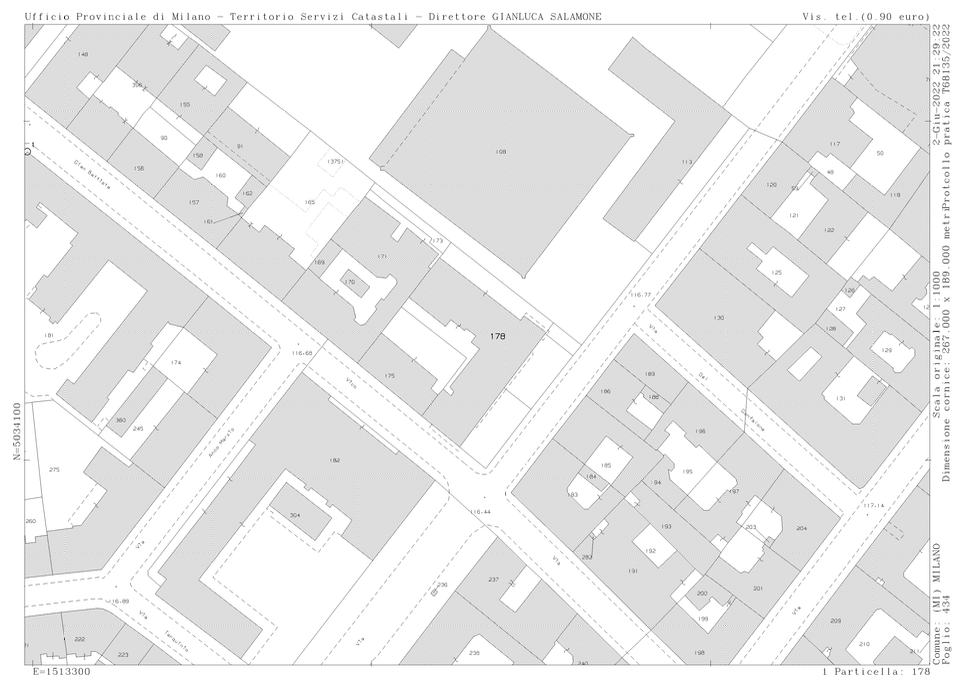
Cadastral compliance is an obstacle to the Thermal Account program
The connection between land registry and sustainability is enshrined in the rules governing access to incentives administered by the GSE (Gestore Servizi Energetici).
To qualify for the Conto Termico, theincentive that supports theimproved energy efficiency and production of thermal from renewable sources, the cadastral compliance is an absolute prerequisite.
A concrete example: a Municipality might have the funds and the project To install a heat pump in a school, but if the cadastral map does not reflect the exact layout of the rooms; the request for incentive of the Thermal Account is rejected.
Without the regularity cadastral, the speech not it can be admitted to the benefit, depriving thepublic agency (or the private sector) of incentives that could cover up to 100% of the expenses incurred.
The Roots of the Problem of Cadastral Accuracy: A Complex Historical Evolution
To understand the current state of documentary chaos, it is necessary to examine the history of the Land Registry in Italy, which was officially established by the law of 1886 that established the Land Registry for the purely tax (“tax equalization”).
It was not until 1939 that the New Urban Building Cadastre (NCEU) was established, but for decades the system operated on a self-reporting basis and used surveying methods that, while advanced for their time, lacked the digital precision of today.
Many public buildings date back to periods when priority was reconstruction orurban expansion, often at the expense oftimely updating of maps. This historical legacy has created a divide between the physical reality of real estate and its administrative representation—a laxity that today is revealed in all its criticality in the face of the strict standards required by modern regulations.
Operational Challenges
Very often, the property owners are genuinely unaware of cadastral deficiencies that weigh on one’s assets. Once identified, however, it is possible to resolve these situations and comply with cadastral records It is not straightforward. The main challenges include:
- Fragmentary archives: often the historical documents in municipal engineering offices are incomplete or damaged.
- Amnesty Costs: bring into bring the floor plans requires technical surveys, professional invoices and, if applicable, payment of penalties for late reporting.
- Bureaucratic delays: the update procedures (DOCFA) require processing time that often conflict with the deadlines for funding calls.
The solution to land registry compliance lies in transparency
The cadastral regularity must stop being viewed as a bureaucratic burden and start being considered the indispensable foundation for any investment.
For the Public Administration, invest in the regularization of their own real estate databases It is not just an act of transparency, but a financial investment: only through buildings that have been properly registered It is possible unlock funds necessary to make our the most modern cities and sustainable. Without accurate maps, the route to the energy future remains uncertain.
Cadastral Compliance: How the Enertech Solution Team Can Help You
If you have any doubts that the building stock that you’re about to redevelop is not properly registered, don’t let yourself get caught up in the panic and Contact us: We will take care of it analyze the current situation, identify the issues and the related solutions.
Keep in mind, however, that the activities of regulation They need technical times, so start the process while you’re still in the design, so that we have the time and the means to remedy the inconsistencies before the closure of the construction site.