




Photo by Minddandib on Freepik
Author: Francesca Ciccolella
Key Points of the Article
- BIM regulations are based on international (UNI EN ISO 19650) and national (UNI 11337) standards, which guide the digitization of construction processes.
- LODs (Levels of Development) define the level of informational and geometric detail of objects in BIM models.
- Each LOD, from A to G, corresponds to a phase in the project’s life cycle and to an increasing level of definition.
- The concept of LOIN (Level of Information Need) was developed to avoid information overload and focus only on what is necessary.
- The most recent regulations call for a transition from LODs to LOINs to ensure more efficient, targeted, and sustainable management of BIM models.
What Is BIM and Why Is It Relevant in Regulations?
The BIM (Building Information Modeling) is a working methodology used in the design, construction, and management of building and infrastructure projects. BIM models are interdisciplinary, shared information models that contain data covering the entire life cycle of the project.
Within this methodology, BIM standards play a fundamental role in defining the information standards required at every stage of the design process. Two key concepts in this context are LOD (Level of Development) and LOIN (Level of Information Need).
We are here to help you
Please contact us for any information you may need.
The latest news from the industry
Receive the latest articles from our blog on your email
LOD (Level of Development): Meaning and Regulatory Definition
Within the BIM methodology, LODs define the level of development of the digital objects that make up the models, specifying the quantity and quality of the information content. They are tools designed to help achieve the model’s design and management objectives, depending on the phase of the process in which they are used and the objectives of the model to which they relate.
The Two Definitions of BIM LOD
The acronym “LOD” can have two distinct meanings depending on whether the British or American definition is used:
- Level of Definition (English definition)
- Level of Development (U.S. definition)
In both cases, this is a scale of levels to which a standard nomenclature is assigned, which varies depending on the applicable regulations.
BIM Regulations in Italy: UNI 11337
In Italy, the relevant standard is UNI 11337, “Building and Civil Engineering Works—Digital Management of Construction Information Processes”; specifically, LODs are addressed in Part 4:
“The Evolution and Informational Development of Models, Documents, and Objects.“
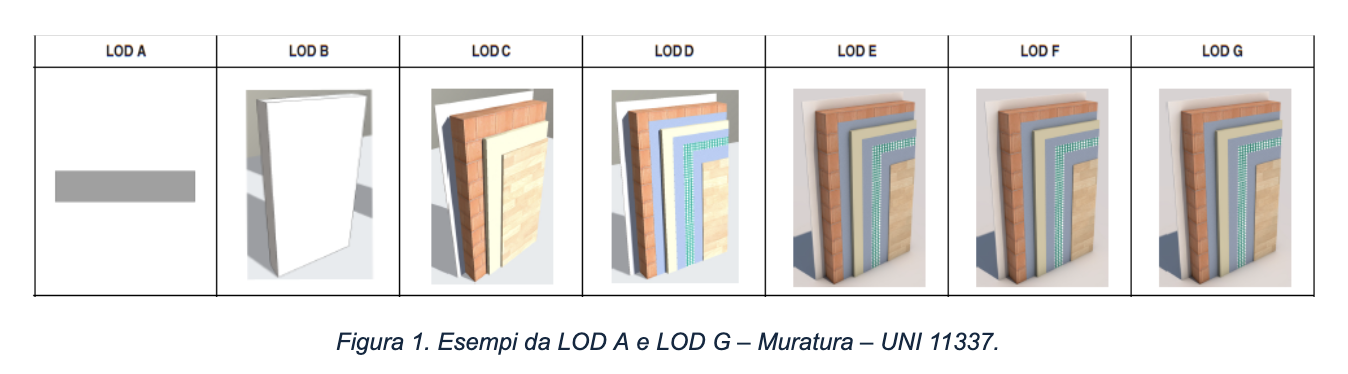
This standard breaks down LODs into a graphical and textual/multimedia structure, which includes, for example: schedules, costs, sustainability, management, and maintenance. The standard defines a generic LOD scale used as a general reference framework, which classifies BIM LODs into:
- LOD A (symbolic object): Entities are represented graphically using a symbolic geometric system. Quantitative and qualitative characteristics (performance, size, shape, location, cost, etc.) are indicative;
- LOD B (generic object): Entities are graphically represented as a generic geometric system. Qualitative and quantitative characteristics are approximated;
- LOD C (defined object): Entities are graphically represented as a defined geometric system. Qualitative and quantitative characteristics are defined in general terms, in accordance with the limits set by current regulations and relevant technical standards;
- LOD D (detailed object): Entities are graphically represented as a detailed geometric system. The interface with other specific construction systems is defined, including approximate clearance dimensions for operation and maintenance;
- LOD E (specific object): Entities are graphically represented as a specific geometric system. The level of detail regarding fabrication, assembly, and installation is defined, including specific clearance requirements for operation and maintenance;
- LOD F (as-built object): These objects represent the virtualization verified on-site for the specific production system as built. For each individual product, the management, maintenance, and/or repair and replacement tasks to be performed throughout the entire life cycle of the structure are defined;
- LOD G (updated object): Objects represent an updated virtualization of an entity’s current state at a specific point in time. For each individual product, the management, maintenance, and/or repair and replacement tasks to be performed throughout the entire life cycle of the structure are defined.
The Role of LOD in BIM Methodology
Within the BIM methodology, the concept of LOD has introduced a model structure based on geometric data enriched with informational attributes such as materials, performance, technical characteristics, and costs.
However, the definition of LODs and their associated content may vary from country to country, depending on the standard adopted. In fact, each standard establishes a specific correlation between the model’s objectives and the required levels of detail.
It is important to emphasize that BIM models can be developed with varying levels of detail, both graphical and informational. However, an excess of unnecessary information risks compromising the efficiency and smooth flow of design processes. To address this challenge, the concept of LOIN (Level of Information Need) was introduced.
From LOD to LOIN: The New Approach in BIM Regulations
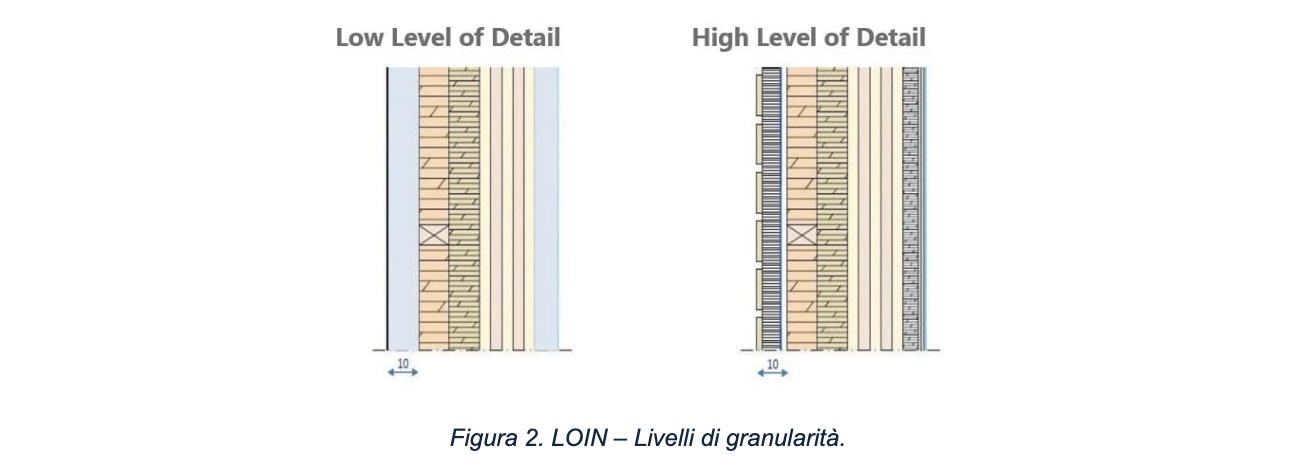
The LOIN BIM shifts the focus from the level of graphical detail to the actual information needs—that is, the information that is actually required at a specific point in the process.
This approach is introduced by the UNI EN ISO 19650 standard, Part 1:
“Organization and digitization of information related to construction and civil engineering projects, including BIM—Information management using Building Information Modeling.”
The goal of LOIN is to avoid including unnecessary information in BIM models and to focus on what is needed to make decisions or carry out specific tasks. The regulations therefore call for a transition from LODs to LOINs, where the level of detail is defined based on the project and its phases.
How Are LOINs Defined?
The definition of LOINs is based on a description of the granularity of the information exchanged, specifying how much and what kind of information must be included in each object based on:
Prerequisites based on:
- Purpose of the Information to Be Provided
- Deadlines for Submitting Information
- Stakeholders involved in the information flow
- Objects organized into one or more decomposition structures
Information needs, based on:
- Type of geometric representation to assign to the object
- Types of alphanumeric information
- Documentation associated with the item
Conclusion: Regulatory Developments and the Central Role of Information
The LOIN BIM concept represents a breakthrough in BIM regulations, moving beyond rigid standardization to offer flexible and targeted information management. This approach makes it possible to optimize BIM models, adapting them to the actual needs of professionals at every stage of a project’s lifecycle. Contact us for a consultation on BIM services.