




Photo by D koi on Unsplash
Authors: Federico Re Ferrè
We are here to help you
Please contact us for any information you may need.
The latest news from the industry
Receive the latest articles from our blog on your email
The growing interest in hydrogen as an energy carrier for decarbonization has led to its use even in sectors where it may not be cost-effective; one such sector is residential heating.
The use of boilers In fact, systems powered entirely by hydrogen are not competitive, except in certain situations. Residential heating is not defined as a “hard-to-abate” sector—that is, a sector in which it is difficult to reduce climate-altering emissions; in fact, a sector is not classified as “hard-to-abate” if electrification succeeds in reducing or eliminating CO₂ emissions 2, which are typically produced by the combustion of hydrocarbons. In this sector, hydrogen’s main competitor is the electric heat pump, which is highly efficient. Below, we illustrate the difference in efficiency between the two methods using a simplified example.
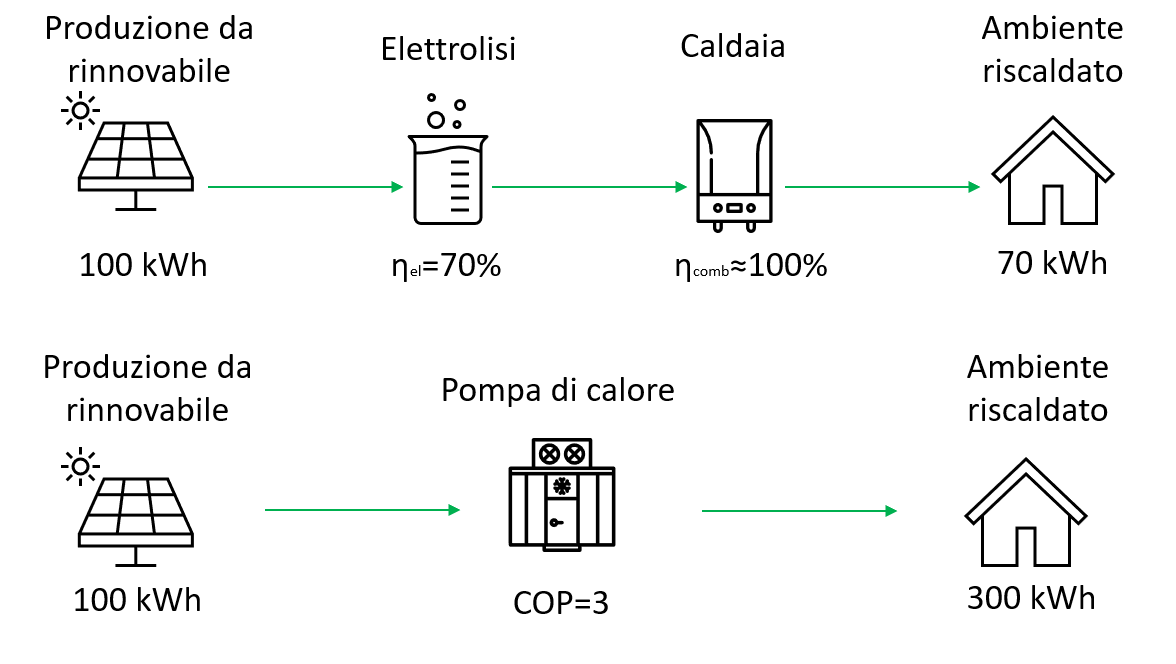
Suppose we have 100 kWh of electricity generated from renewable sources. Let’s assume we want to use it to heat a building, and we’ll explore two options: green hydrogen production to power a boiler and direct use of the electricity to power a heat pump:
- In the first case, assuming an efficiency of electrolysis efficiency of 70% including auxiliary systems (a figure that is set to increase significantly in the future but which accurately reflects the current state of the art, considering all technologies available on the market) and a boiler efficiency close to 100% , we would find that 70% of the initial energy has been converted into usable heat (which is then further reduced due to distribution, emission, and regulation losses common to all types of systems);
- In the second case, the 100 kWh of electricity powers an electric heat pump that realistically has a COP close to 3. It follows that approximately 300 kWh of heat should be considered the final output, net of other losses that were also neglected in the previous case.
From the considerations outlined above, it is clear that the heat pump option is significantly more efficient, providing 300 kWh of thermal energy for heating compared to 70 kWh for the hydrogen option—more than four times as much.
In the scenarios just described, losses associated with hydrogen storage and distribution were disregarded for the sake of simplicity, assuming that the hydrogen is produced locally (an assumption underlying many future projects, such as “hydrogen valleys,” which aim to create ecosystems where hydrogen is produced and consumed locally); similarly, losses associated with electricity transmission have not been accounted for.
In this case, the use of hydrogen therefore does not appear to be cost-effective unless certain boundary conditions are met. There are several factors to consider:
- Heat pumps experience a drastic drop in efficiency at particularly low ambient temperatures, which is why hydrogen as a fuel may be necessary in extremely cold climates where heat pumps cannot guarantee continuous service;
- The most common heat pumps cannot reach particularly high temperatures, unlike boilers, which is why they are often paired with low-temperature systems (e.g., radiant floor heating) or used to supplement boilers;
- Heat Heat pumps cannot always be installed when there are strict landscape restrictions. One notable example is the pilot project in Lochem, a city in the eastern Netherlands, where 12 early 20th-century homes had 100% hydrogen-powered boilers installed because they could not install other options due to the aforementioned landscape restrictions. The boilers are powered by hydrogen fed into the gas grid and produced via electrolysis using solar panels installed in a nearby industrial area.
It should also be noted that comparing the efficiency of hydrogen boilers and heat pumps makes sense only if we assume the use of renewable electricity or electricity drawn from the grid in general; in the hypothetical case where it is possible to use industrially produced hydrogen obtained as a byproduct of other processes, this drastically changes the economic assessment, as there is no waste of electricity.
Ultimately, a 100% hydrogen solution for heating does not appear to be competitive but all the relevant conditions must be taken into account in order to understand the situations in which it can be applied.
The use of methane-hydrogen blends will, however, become more common in boilers in the future.
The continued growth of renewable energy sources raises the issue of energy storage. One viable solution will be the conversion of electricity into hydrogen to be fed into the gas grid (a strategy known as “power-to-gas”) during periods of unutilized renewable energy peaks. High hydrogen concentrations (20% and above) do not appear feasible for both technical and economic reasons, but hydrogen concentrations of up to 10% will be more easily technically feasible and economically sustainable. To date, the first standard regarding hydrogen boilers was issued in February 2022: UNI/TS 11854:2022, which covers heat generators operating on methane-hydrogen mixtures containing up to 20% hydrogen by volume.