



Photo by Enertech
Author: Federico Re Ferrè
Key Points
- The Smart Readiness Indicator assesses the ability of buildings to utilize smart technologies. It measures how well the building adapts to internal and external conditions and to the needs of its occupants, in accordance with European Commission guidelines.
- Smart technologies include devices that enable a building to respond to climate changes, occupancy conditions, and energy grids. The regulatory framework is European, while the technical framework is defined by national authorities.
- In Italy, a testing phase for the Smart Readiness Indicator has been launched with the support of ENEA. The trial evaluates the applicability of the technical framework and the potential customization of smart-ready services and weighting factors, with potential integration into the APE.
- The SRI assessment examines nine services, ranging from heating and ventilation to electric vehicle charging. Each service is analyzed based on seven criteria such as energy efficiency, comfort, flexibility, and maintenance, with readiness levels ranging from 0 to 4.
- A high SRI score benefits buildings, occupants, and the community. It increases the building’s value, reduces operating costs, improves comfort, and promotes the stability of the power grid, especially when renewable energy sources are involved.
The Smart Readiness Indicator (SRI) is an indicator promoted by the European Commission that measures a building’s ability to use smart technologies (also known as smart).

Table of Contents
- What Is Meant by “Smart Technologies”?
- Smart Readiness Indicator (SRI) in Italy
- What Does a Smart Readiness Indicator Assessment Include?
- The Seven Evaluation Criteria of the Smart Readiness Indicator
- The Macro-Categories for Evaluating the Smart Readiness Indicator
- How Are Services Categorized in the Smart Readiness Indicator?
- Benefits of the Smart Readiness Indicator
What Is Meant by “Smart Technologies”?
The smart technologies They are the set of systems that provide the building with the ability to adapt to the changing conditions by employment of the building itself, at the weather conditions external, at occupants’ needs and to the external power grids.
While the regulatory framework was established by the European Directives, the technical framework must be provided by the national authorities.
Smart Readiness Indicator (SRI) in Italy
A March 2025, the Ministry of the Environment and the Energy Security has launched a testing phase of 12 months of the Smart Readiness Indicator with the support of theNational Agency for the new technologies, theenergy and the sustainable economic development (ENEA). The goal is to verify the practical applicability of the Technical Framework of the SRI in the Italian context and assess the need for any necessary adjustments, such as customization of the catalog of smart-ready services and adjustment of the weighting.
The testing phase will also explore the possible integration of the Smart Readiness Indicator into theEnergy Performance Certificate (APE).
The nonresidential buildings with a rated power of air conditioning systems greater than 290 kW must be equipped by December 31, 2027 by automation systems and inspection and will be required to evaluation second Smart Readiness Indicator.
On a voluntary basis, however, the assessment according to SRI It will be available for all other types of buildings. In Italy There are already case studies on SRI, such as the La Forgiatura Campus in Milan and the Monte Rosa 91 in Milan, the former headquarters of Sole 24 Ore.
What Does a Smart Readiness Indicator Assessment Include?
A Smart Readiness Indicator assessment involves examining nine services (often referred to as technical domains), namely:

Heating

Cooling

Domestic Hot Water

Ventilation

Lighting

Dynamic Building Envelope

Electrical System

Charging Electric Vehicles

Monitoring and Remote Control
The Seven Evaluation Criteria of the Smart Readiness Indicator
The evaluation aims to assess how these nine services impact the following seven criteria:
Energy efficiency: energy savings resulting from smart technologies.

Adaptation to the Electric Grid: Energy Flexibility of the building, also taking into account district heating and district cooling.

Data from thermo-hygrometric of theair, noise levels and room lighting.

Ease of Use: Simplifying the Use of the Building thanks to Smart Ready and by reducing manual operations.

Well-being and Health: users’ well-being and health.

User Information: Providing Information About services to the user.

Maintenance and Fault Prediction: detection automatic of faults.
The Macro-Categories for Evaluating the Smart Readiness Indicator
The Smart Readiness Indicator therefore assesses three broad categories:
- Energy Savings: system efficiency and optimization capabilities.
- Energy Flexibility: the ability to interact with the electric grid and any district heating and/or district cooling
- Comfort: the quality of the indoor environment for occupants.
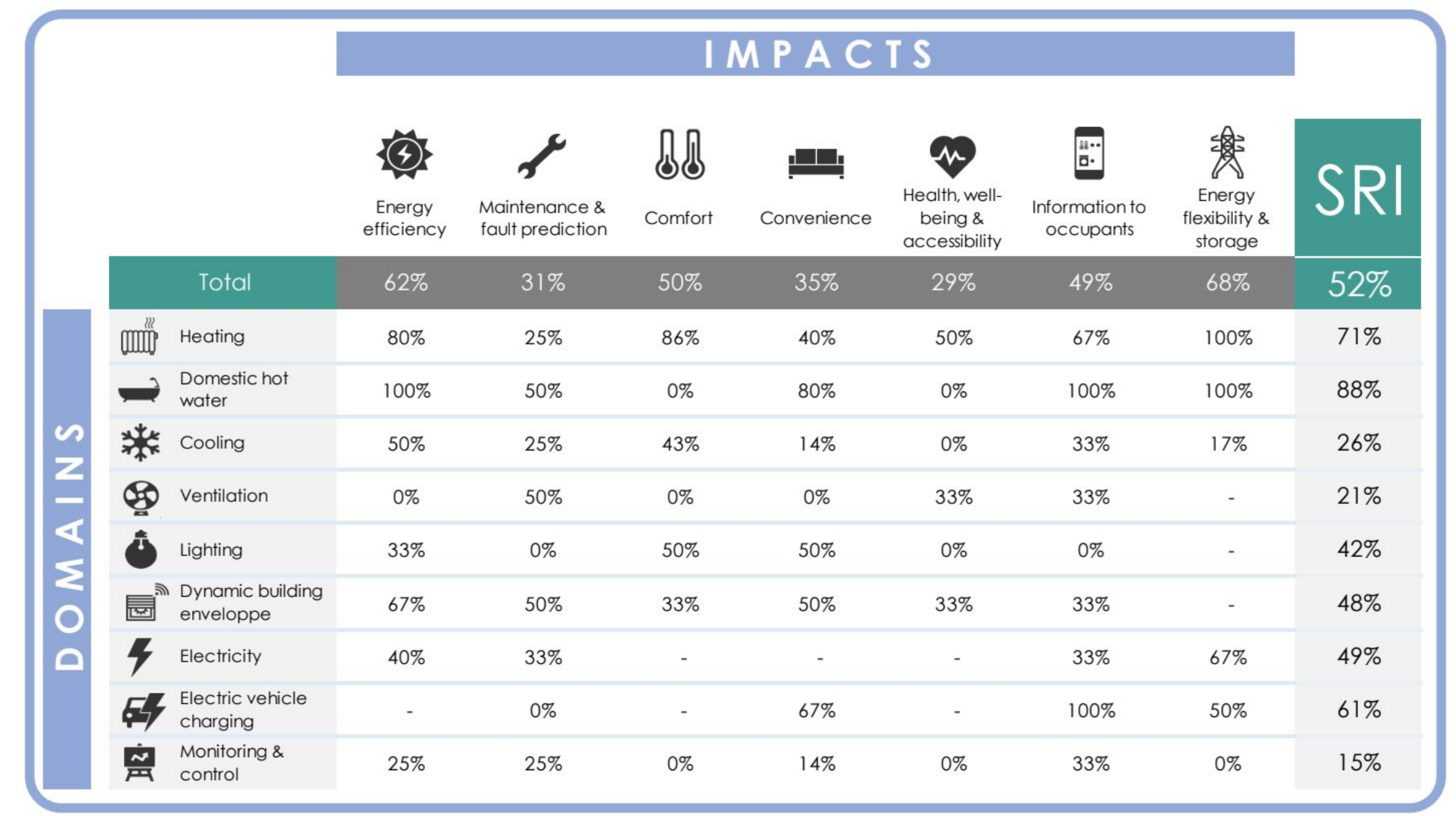
The index therefore assigns a rating to each pair service/criterion pair, expressed as a percentage: 0% system without automation, 100% fully smart system.
As shown in the following screenshot, each service has a weight for each domain, and together they all contribute to defining the Smart Readiness Indicator.
How Are Services Categorized in the Smart Readiness Indicator?
Each service is evaluated for each domain on a readiness scale ranging from 0 to 4:
- Level 0: service is unavailable or not smart, for example, radiators without thermostats for heating or lighting with traditional on/off switches;
- Level 1: system with manual or programmed control, for example manual thermostats for heating and timers with hourly programming for the lights;
- Level 2: system with reactive control (responds to events), for example sensors that measure the temperature and that adjust the heating based on the presence of the people, lighting control based on outdoor lighting and number of people present, ventilation which modulates into absence of people, facilities for air conditioning that They turn off if they detect open windows, sunshades that are activated when intense radiation;
- Level 3: system with predictive control (anticipates needs), such as systems that use weather forecasts and machine learning algorithms based on user habits to anticipate the thermal loads required or adjust the light intensity of the lamps based on the forecast of natural light, preheating mode the building before occupants arrive;
- Level 4: system with advanced optimization and Network interaction with features as peak shaving (automatic reduction of consumption peaks), Vehicle-to-Grid that is, the use of vehicle batteries being charged to stabilize the network and storage management, that is, to coordinate theenergy storage with the photovoltaic power generation and the internal loads to optimize efficiency.
Calculating the Smart Readiness Indicator is done by sum of all services assessed according to their level of intelligence and specific weight of each domain.
Benefits of the Smart Readiness Indicator
The benefits ofimplementing advanced automation systems that feature high values of Smart Readiness Indicator are numerous and benefit multiple stakeholders:
- Property owners have a property with ahigh market value, with low operating costs and can more easily access incentives and funding;
- Residents can enjoy a building offering a high level of comfort , while the community as a whole benefits from buildings that contribute to the stability of the power grid (which will face increasing strain in the future as loads increase and the penetration of intermittent and unpredictable sources such as renewables).
The Smart Readiness Indicator is set to become a new building assessment tool And with it, we’ll also see the emergence of new professional roles (the evaluators SRI, which must be specially trained for conduct evaluations); everyone, from property owners to BEMS system designers including technicians from will prepare APE reports will be involved in this new tool which will drive theenergy efficiency to a higher level by moving the buildings from primarily static entities to entities that are increasingly dynamic and intelligent.
For more information about the Smart Readiness Indicator please contact our team at Enertech Solution.