




Author: Federico Re Ferrè
Materials for passive daytime radiative cooling (PDRC) represent the new frontier in cooling buildings and combating urban heat islands.
While efforts to improve plantefficiency are moving towardthe electrification of renewable energy sources, the aspect related to thebuilding envelope is also moving toward increasingly efficient and innovative solutions; one of these is Passive Diurnal Radiative Cooling (PDRC).
Key Points on Passive Diurnal Radiative Cooling
- PDRC materials combine high solar reflectance with high infrared emissivity.
- Passive daytime radiative cooling (PDRC) can cool surfaces to below ambient temperature.
- In very humid or cloudy conditions, the cooling effect is significantly reduced.
- Applications include buildings, district cooling, and photovoltaic cells.
- High costs and material degradation are key challenges to the widespread adoption of this technology in the construction industry.
Table of Contents
- What Is Passive Diurnal Radiative Cooling?
- From RC materials to daytime radiant cooling
- How does radiative exchange with space occur?
- Which materials allow for radiative cooling?
- Where are materials for passive diurnal radiant cooling (PDRC) used?
- Costs and Durability of Materials for Passive Diurnal Radiative Cooling (PDRC)
- Frequently Asked Questions About Materials for Passive Diurnal Radiative Cooling (PDRC)
- PDRC Materials and Building Energy Efficiency
What Is Passive Diurnal Radiative Cooling?
Passive Radiative Cooling During the Day (PDRC) is a technology based on the fact that certain materials are excellent reflectors and emitters of infrared light.
In the spectral band between 8 and 13 micrometers, the atmosphere does not absorb infrared radiation, which is scattered into space. Materials suitable for passive daytime radiative cooling achieve high solar reflectance (typically close to 95%), reducing daytime heatabsorption, andhigh emissivity (over 90%) precisely in the 8–13-micrometer range mentioned earlier.
From RC materials to daytime radiant cooling
The experimental demonstration of daytime radiative cooling dates back to 2014, when a group of researchers at Stanford succeeded in showing that cooling was possible in broad daylight, even under direct sunlight. Over the past 10 years, research has focused on materials that enable passive daytime radiative cooling, leading to the development of several prototypes; however, large-scale commercial adoption remains limited.
It is worth noting that materials that are highly emissive and capable of cooling throughradiative emission have existed for a long time.
As early as the 1970s , research was conducted on traditional RC (Radiative Cooling) materials , primarily polymers such as polymethyl methacrylate (PMMA), polyvinyl chloride (PVC), and polyphenylene oxide (PPO); the limitation of these materials is that they could cool only under certain conditions, and when exposed to direct light, this effect did not persist because their low reflectance values caused the the net radiation from the sun was far greater thanthe emissivity.
Essentially, these materials were unable to achieve a reflectance high enough to reflect sunlight and cool down even when exposed to the sun.
The revolutionary breakthrough achieved in 2014 by the Stanford team was demonstrating the possibility of daytime radiative cooling using materials that combined the two desired characteristics: high emissivity in the LWIR band (Long-Wave Infrared, i.e., 8–13 µm) and extremely high solar reflectance.
However, performance depends heavily on local weather conditions: in very humid or cloudy environments, the effect is significantly reduced, since water vapor in the atmosphere absorbs some of the infrared radiation that would otherwise reach space.
How does radiative exchange with space occur?
Cooling is possible because radiative exchange occurs between the Earth, which is at room temperature (about 300 K), and space (about 3 K). Since space emits much less radiation than Earth (radiation increases as temperatures rise), Earth is able to dissipate heat into space.
However, the Sun is a net emitter toward Earth, while Earth, on the other hand, absorbs more from the Sun than it emits, since the Sun’s temperature is much higher. Earth, therefore, is a net emitter into space and a receiver with respect to the Sun.
Materials for daytime passive radiative cooling (PDRC), which combine high LWIR emissivity (they are net emitters into space in the LWIR infrared band) with high reflectance (they reflect nearly all the solar radiation they receive), are able to cool below ambient temperature.
Which materials allow for radiative cooling?
There are three main types of materials that enable passive diurnal radiative cooling (PDRC), based on the primary cooling mechanism:
- by issue,
- by transmission,
- for reflection.
Radiative Cooling
Emission- cooled materials use the mechanism already discussed, the material reflects virtually all radiation from the sun and emits strongly, selectively if only in the LWIR band, or non-selectively if it emits in all wavelengths, thereby not only avoiding heating up from the Sun but also cooling down to below room temperature.
Cooling via transmission
Materials with transmission cooling have high transmittance in the infrared spectrum (and are therefore transparent to infrared radiation) and allow a large amount of radiation to pass through.
If there is an underlying emitter, they allow the thermal radiation emitted by the underlying layer to pass through them; however, if they are exposed to sunlight, they also allow the infrared component of solar radiation to reach the underlying emitter layer, heating it.
These materials are therefore suitable for applications where there is nodirect exposure to sunlight or when the underlying emitter layer itself has excellent reflective properties.
Reflective Cooling
The mechanism behind reflection-cooling materials is the easiest to explain, as they possess extremely high non-selective reflectivity (they are nearly perfect reflectors across all wavelengths) but lack the emissivity or transmittance characteristics of other materials. Ultra-white paints, for example, fall into this category.
These materials are therefore able to prevent overheating, but they rarely cool down below the target temperature as they do in other cases.
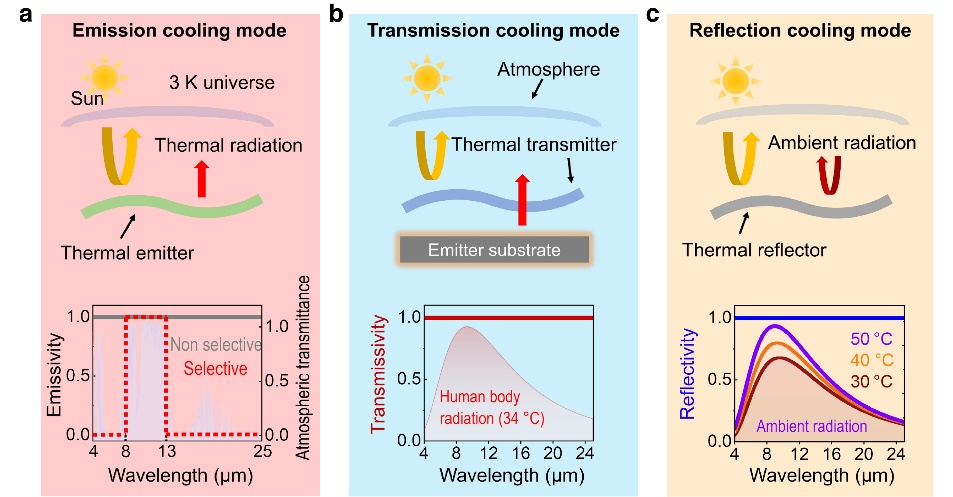
Figure 1. The three types of RC materials. Source: “Progress in Passive Daytime Radiative Cooling from Spectral Design to Real Application,” Carbon Future.
Where are materials for passive diurnal radiant cooling (PDRC) used?
PDRC materials can be used in a wide variety of applications, such as:
- urban cooling,
- building cooling,
- water collection,
- cooling of photovoltaic cells ( cooling of photovoltaic panels),
- clothing designed to regulate body temperature,
- materials for dynamic thermal regulation.
Costs and Durability of Materials for Passive Diurnal Radiative Cooling (PDRC)
In the construction industry, positive results have been achieved with PDRC materials in the form of paint or film. Unfortunately, these materials are still expensive and are prone to degradation when exposed to the elements for extended periods.
RigidPDRC materials have also been developed; unlike films and coatings, they are more durable and robust, although the issue of high costs remains.
Frequently Asked Questions About Materials for Passive Diurnal Radiative Cooling (PDRC)
What are PDRC materials?
PDRC stands for Passive Daytime Radiative Cooling, which refers to materials that cool passively (without the need for electricity or other energy sources) through radiative exchange with the sky, even during the day—that is, in the presence of sunlight.
Does passive radiative cooling work at night, too?
Yes, it works—and even better than that. At night, there is no solar radiation to reflect, so PDRC materials can focus exclusively on emitting thermal radiation into space.
How much can a surface actually cool down using PDRC technology?
Under optimal conditions (clear skies, low humidity, good exposure), the most advanced PDRC materials can reach temperatures 5–10°C below ambient temperature even in broad daylight. Typical cooling capacity is around 100–150 W/m².
PDRC Materials and Building Energy Efficiency
Passive daytime radiative cooling is one of the most promising innovations in the field of building energyefficiency.
Although the technology still faces some technical and economic challenges before it can be widely adopted, the results already achieved in the first commercial applications demonstrate significant potential.
The Future of decarbonization andenergy efficiency in buildings will inevitably rely on PDRC materials to reduce cooling needs while simultaneously lowering the risk of urban heat islands.
For more information on the different types of PDRC materials and their applications please contact the Enertech Solution team.