



Photo by D koi on Unsplash
Author: Federico Re Ferrè
The use of hydrogen in the fight against climate change is one of the most hotly debated topics: from transportation to heating, seasonal energy storage, and the industrial sector, there are many sectors involved. One of the most frequently mentioned uses of hydrogen is its injection into the natural gas grid to reduce methane use and limit climate-altering emissions.
With this in mind, to reduce the grid’s carbon footprint, hydrogen must be produced from renewable sources using excess energy during peak periods and must not come from hydrocarbons. This strategy is part of a suite of technologies often referred to as POWER-TO-GAS (sometimes abbreviated as P2G), which involves the production of gaseous fuels—such as hydrogen—from electricity, often following a surplus of renewable energy production.
We are here to help you
Please contact us for any information you may need.
The latest news from the industry
Receive the latest articles from our blog on your email
Technical and Economic Limitations of Hydrogen Distribution in the Network
The differences between hydrogen and methane mean that, depending on the end user, only a small percentage of hydrogen is permissible to ensure the safety and proper operation of machinery. The Fraunhofer Institute for Energy Economics and Energy System Technology has released a study on the injection and distribution of hydrogen into the grid (“The Limitations of Hydrogen Blending in the European Gas Grid”), highlighting the maximum permissible hydrogen levels currently allowed for transmission, storage, distribution, and utilization. A partial graph from the study is shown below. As can easily be seen, a significant portion of appliances—such as condensing boilers and gas stoves—would already be capable of operating with 10% hydrogen without any issues. Nearly the entire system would be capable of handling 10% hydrogen, with the exception of compressors, which, as things stand, would shut down at no more than 5% due to the partial pressure that certain materials can withstand.
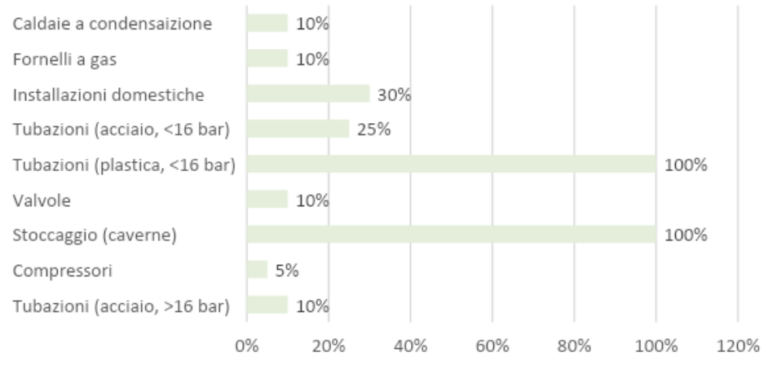
Achieving higher levels—such as a 20% hydrogen blend—is technically feasible but requires substantial investment in the distribution network, particularly in high-pressure systems. As previously mentioned, not all of the distribution network is currently ready for blends with a high hydrogen content due to issues such as hydrogen embrittlement ( a type of corrosion caused by the diffusion of hydrogen into the metal) and leaks. Therefore, major investments would be needed in components such as distribution pipelines, compressors, and valves, as well as in end-user equipment such as boilers.
The necessary investments would be passed on to end users, increasing the cost per unit of energy in the form of gas (a methane-hydrogen blend). A 5% hydrogen blend would not result in particularly noticeable increases in energy costs, which would in fact see an estimated 1% increase at the European level. Reaching a 20% hydrogen blend, on the other hand, would lead to significant increases in the order of 20%. Below are the figures reported by the Fraunhofer Institute for the major European countries:
- Germany: 24.3%;
- France: 18.4%;
- Italy: 27.4%;
- Portugal 43.3%;
- Ireland: 13.1%.
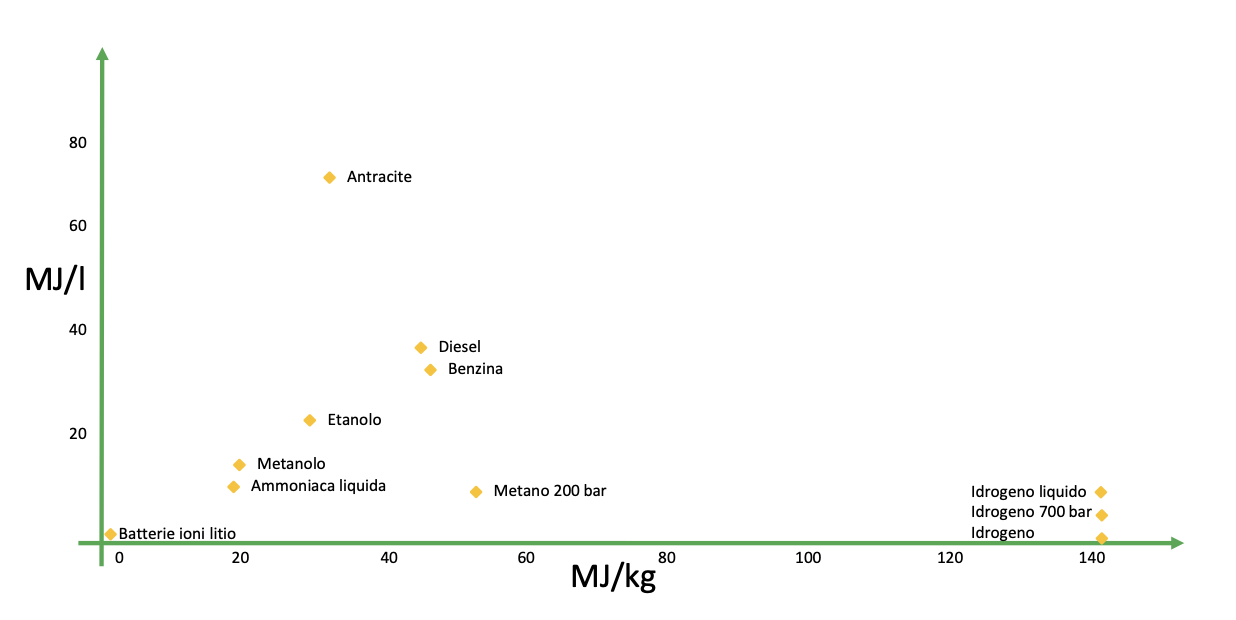
A 20% hydrogen blend by volume would result in an estimated 7% reduction in CO2 emissions. This estimate is based on the fact that hydrogen has a lower heat of combustion than natural gas on a volumetric basis: note that methane contains nearly three times less energy than hydrogen on a mass basis but about three times more energy than hydrogen on a volumetric basis; therefore, for the same volumetric flow rate, replacing 20% of the methane with hydrogen at the same pressure means reducing the energy transported by 14%. The carbon footprint of the gas grid can thus be reduced thanks to hydrogen, but by an amount that may not be fully justified by the costs involved. Producing methane from renewable hydrogen, on the other hand, would eliminate the need to make adjustments to existing infrastructure.
Conclusions
Ultimately, it does not currently seem feasible (given the current state of the art) to adopt hydrogen concentrations exceeding 10%, as they would not yield environmental benefits significant enough to be economically justified for users without massive government incentives. However, the increasing installation of renewable energy sources will lead to more frequent energy peaks that are difficult to store; for this reason, feeding hydrogen into the grid at low concentrations will be a viable option for reducing the grid’s carbon footprint and better managing the renewable energy mix.