



Author: Federico Re Ferrè
Key Points About PICV Valves
- PICV valves serve a dual function of balancing and regulating in hydronic systems.
- The differential regulator compensates for pressure fluctuations, allowing the control section to regulate flow under the expected conditions.
- Pressureindependence applies within a specific operating range: the valve’s limits must be observed.
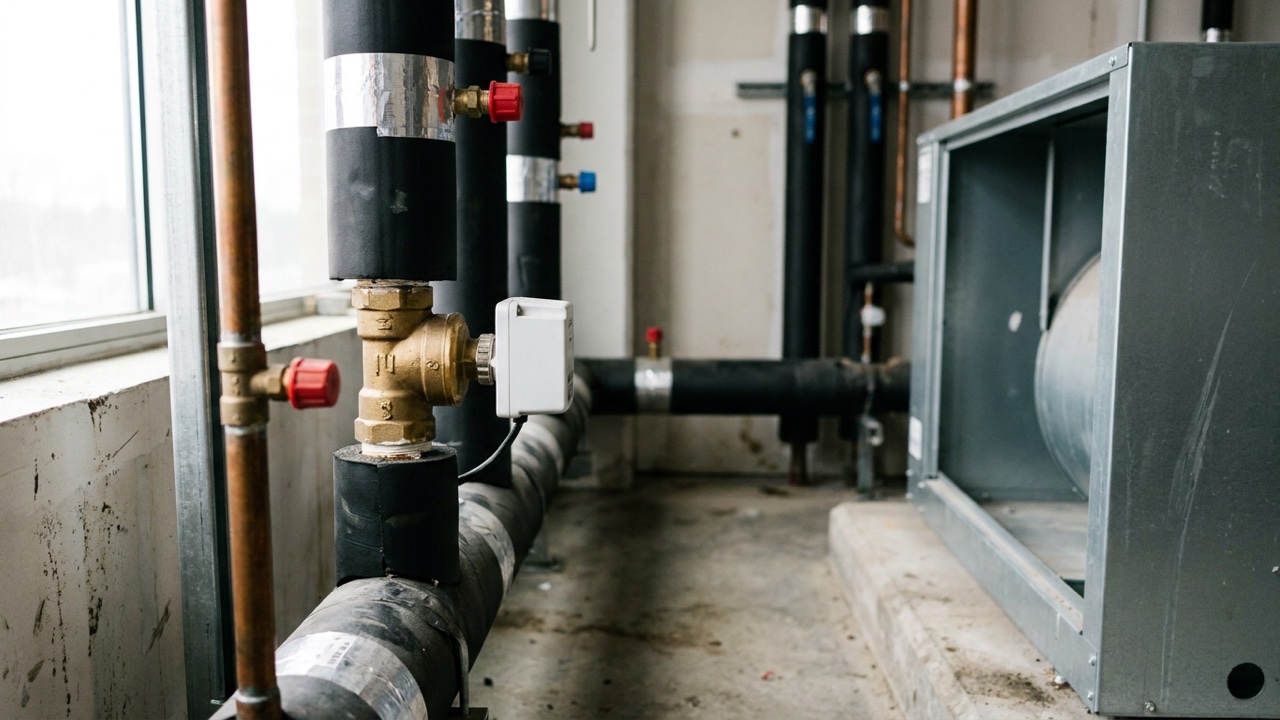
- PICV valves are used in systems with fan coils, AHU coils, variable-speed pumps, and numerous terminals.
- In electronic versions equipped with the necessary functions and sensors, control can range from flow rate to heating capacity.
Pressure-independent control valves (PICVs) are one of the most important tools for regulating and balancing a hydronic system, but how they work and why they should be used is often unclear.
The acronym PICV stands for Pressure Independent Control Valve. These valves combine flow control with compensation for changes in differential pressure within their operating range.
Table of Contents
- Why does the flow rate change in hydronic systems without PICV valves?
- What Are PICV Valves and How Do They Work?
- Control valve and differential pressure regulator
- How does a PICV respond to pressure changes: a numerical example
- Balancing and control: What is the operating range of PICVs?
- PICVs and traditional valves: how does valve authority change?
- Electronic PICVs: Flow Measurement and Power Control
- Where PICV Valves Are Used
- PICVs: More Stable Regulation for Indoor Comfort
- Frequently Asked Questions About PICV Valves
- PICV Valves and Hydronic System Design
Why does the flow rate change in hydronic systems without PICV valves?
To understand the challenges of adjusting a hydronic system, let’s look at an example using another system, such as a lighting system. Suppose we have a building with three rooms, all equipped with dimmable lighting.
Now suppose that the luminous flux can be adjusted using a switch with a scale ranging from 0 to 100. If you want 70% of the light output, set the switch to 70%, but note that when someone turns on the light in the other two rooms of the building, you’ll experience a drop in your light output: the switch still reads 70%, but the number of lumens emitted is now lower.
This creates difficulties for you when adjusting the lighting, since 70% of the maximum lumens are not emitted when the switch is always in the same position: if the light is turned on in another room while you’re in your room, the luminous flux in your room decreases; if it’s turned off, the luminous flux in your room increases.
Fortunately, a lighting system doesn’t have these problems, but something similar does occur in a hydronic system.
In the same building, there are three fan coils, one for each room. Each has a pressure regulation valve . When a valve is open 70%, a flow rate X passes through, which however depends not only on the degree of opening of the valve but also on the conditions of the other hydronic branches .
If 1 out of 2 of the other fan coils is open, the flow rate with the valve at 70% is X; if both of the other fan coils are closed, the flow rate will be greater than X (since the pressure to be relieved is directed to the single open terminal), but if both of the other fan coils are open, the flow rate will be less than X.
The difference in flow rate consequently results in a difference in heating capacity and makes it more difficult to achieve comfort. In reality, such a small system with only three fan coils would not exhibit significant imbalances, but the principle applies to much larger systems with dozens or hundreds of terminals or with very large terminals such as AHU coils.
What Are PICV Valves and How Do They Work?
A dynamic PICV is a valve that functions both to balance and regulatethe system. A valve of this type is called“pressure-independent”precisely because it is able to maintain a constant flow rate even as pressure conditions change.
Control Valve and Differential Pressure Regulator
A PICV consists of at least two parts: a control valve and a differential pressure regulator .
The control valve, visible at the top of the photo, functions like a standard control valve by partially restricting the flow path to allow more or less flow to pass through.
The lower part—the differential pressure regulator —consists of a plug and a spring: when the fluid pressure upstream of the valve increases, the fluid itself—flowing through the small tube visible at the bottom left— pushes a diaphragm, which movesthe plug upward, thereby reduce the flow cross-section; conversely, when the pressure decreases, the opposite mechanism occurs, allowing the valve to open further.
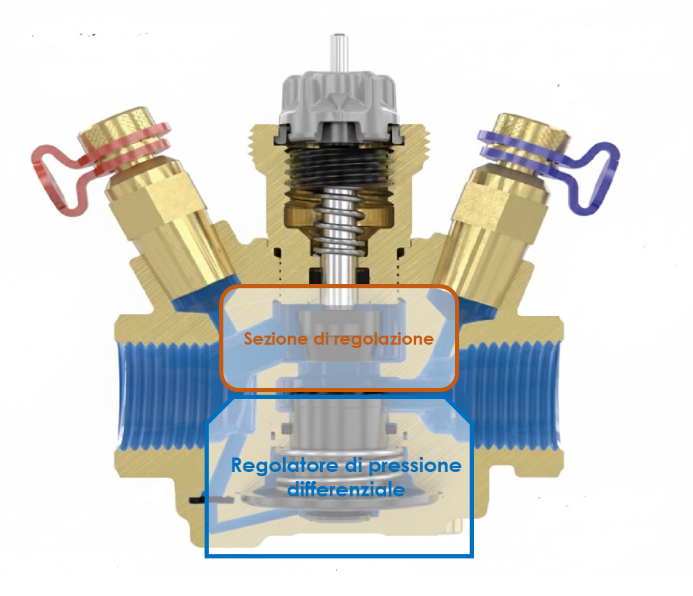
Figure 1. Cross-section of a PICV.
How Does a PICV Respond to Pressure Changes: A Numerical Example
With this simple mechanism, the PICV valve adjusts its flow cross-section to the upstream pressure. Let’s look at a numerical example:
- A circuit consisting of a branch and a terminal has a pressure drop of 15 kPa;
- The available pressure is 50 kPa;
- The PICV is calibrated to maintain 10 kPa across the control valve;
- The PICV must dissipate 25 kPa (50–15–10 = 25) so that the control section always operates at the design pressure of 10 kPa.
If there were an increase in pressure and the available pressure in the branch rose from 50 kPa to 60 kPa, this higher pressure would push against the diaphragm, causingthe valve to close further and dissipating the excess 10 kPa.
If, on the other hand, there were a drop in pressure, the diaphragm would move downward to openthe shutter and reduce the pressure drop across the valve.
Balancing and Regulation: What Is the Operating Range of PICVs?
A PICV valve therefore serves a dual function: balancing and regulating.
The differential pressure control section absorbs pressure fluctuations, allowing the pure control section to operate with a constant pressure drop, thereby achieving linear and precise control.
Although the PICV is extremely flexible, it still has an operating range beyond which it cannot go (the valve is almost fully open at very low ∆P and cannot open any further; similarly, at high ∆P, it would be unable to relieve all the excess pressure).
PICV and Traditional Valves: What Changes in Valve Control
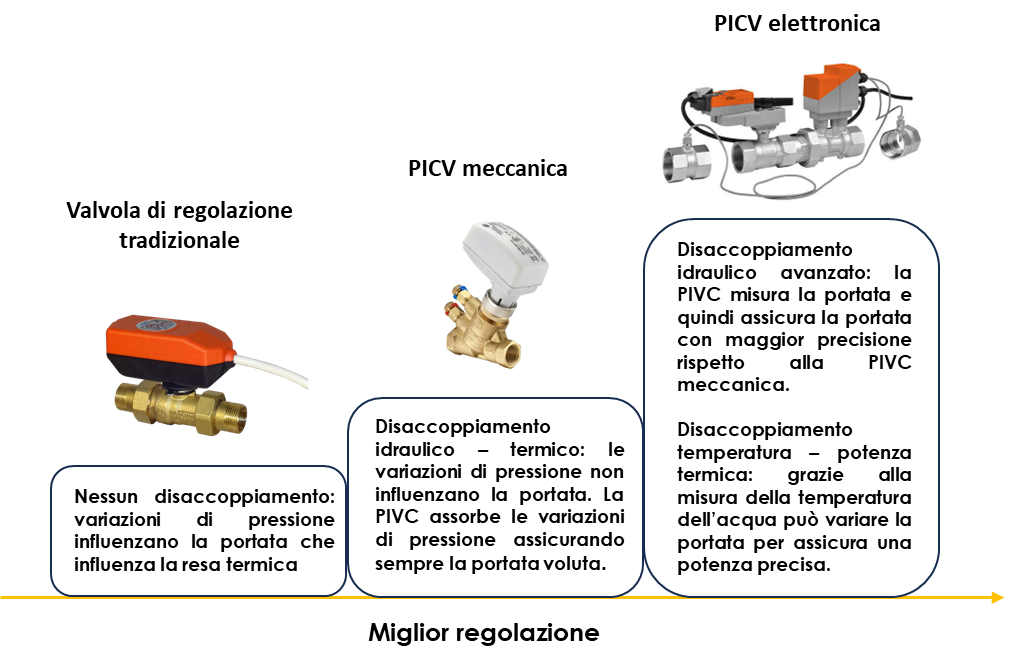
PICV valves thus decouple hydraulic phenomena from thermal control.
With a traditional valve, pressure fluctuations affect the quality of regulation by altering the desired flow rate and, consequently, the heat output at the outlets (which was the point we started from in the initial example and the comparison between a lighting system and a plumbing system).
With a PICV, the pressure variation is canceled out by the differential regulator, and the control section can always operate under design conditions. For this reason, PICV valves are said to have authority level 1 or maximum authority (authority refers to the valve’s influence relative to the rest of the circuit —more precisely, the ratio between the (including the pressure drop across the open valve and the pressure drop across the entire valve circuit), because regardless of the weight of the rest of the circuit, they ensure a constant pressure drop.
No matter how much other factors vary, the PICV ensures that the design conditions are met.
Electronic PICVs: Flow Measurement and Power Control
It is also important to note the existence of the electronic PICV, which features a built-in flow meter: this pressure-independent control valve performs the same functions as the mechanical PICV but with greater precision and can provide a higher level of control.
A PICV valve can achieve an additional level of decoupling by separating temperature fluctuations from the output power: since it can measure the water temperature, if the temperature changes, the valve can in turn adjust the flow rate to ensure the required power.
In this valve, therefore, both pressure and temperature variations are independent of the power output, since the PICV is able to neutralize both.
Where PICV Valves Are Used
PICVs are often used in complex buildings where it is difficult to ensure proper balancing, in systems with variable-speed pumps that experience constant pressure fluctuations, and in variable-flow systems with many outlets that modulate simultaneously.
PICV: More Stable Control for Indoor Comfort
Returning to the initial example of the hypothetical lighting system, PICVs are like smart switches that always deliver 70 percent of the maximum lumens when we set them to 70 percent, regardless of what is happening in the other rooms.
This independence is what makes modern hydronic systems more efficient, comfortable, and easy to manage.
Frequently Asked Questions About PICV Valves
What is a PICV valve?
It is a pressure-independent control and balancing valve: it compensates for dynamic pressure variations to ensure that the flow rate downstream of the valve always remains at the desired level.
What level of authority does the PICV valve have?
PICVs have an authority level of 1 (maximum authority) because the differential regulator automatically compensates for any pressure variation within the operating range.
When the pressure increases,the shutter closes, dissipatingthe excess pressure; when it decreases, it opens, reducing the pressure drop. In this way, the control valve always operates at the same delta P.
Is a motorized actuator always required, or can PICVs operate on their own?
A mechanical PICV alone maintains a constant, pre-set flow rate, but to actively modulate the flow, it must be combined with a thermostat-controlled actuator.
What is the difference between a mechanical and an electronic PICV?
The mechanical PICV uses a passive differential regulator (diaphragm and spring) to maintain a constant pressure differential. The electronic PICV has a built-in flow meter that measures the actual flow rate and can also compensate for variations inwater temperature, maintaining a constant heat output rather than just the flow rate.
How do you choose a PICV valve?
Selecting a PICV valve begins with determining the design flow rate and verifying the available differential pressure range. You must also consider the minimum controllable flow rates and the characteristics of the terminal, referring to the manufacturer’s technical data.
Do PICVs work with any differential pressure?
No. PICVs compensate for pressure variations only within their operating range. Below the minimum or above the maximum specified range, the regulator can no longer maintain the conditions necessary for pressure-independent regulation.
PICV Valves and Hydronic System Design
When selecting PICV valves, it is necessary to consider thesystem’s flow rates and pressures.
To evaluate control solutions for your building, learn about the building systems design or contactthe Enertech Solution team.